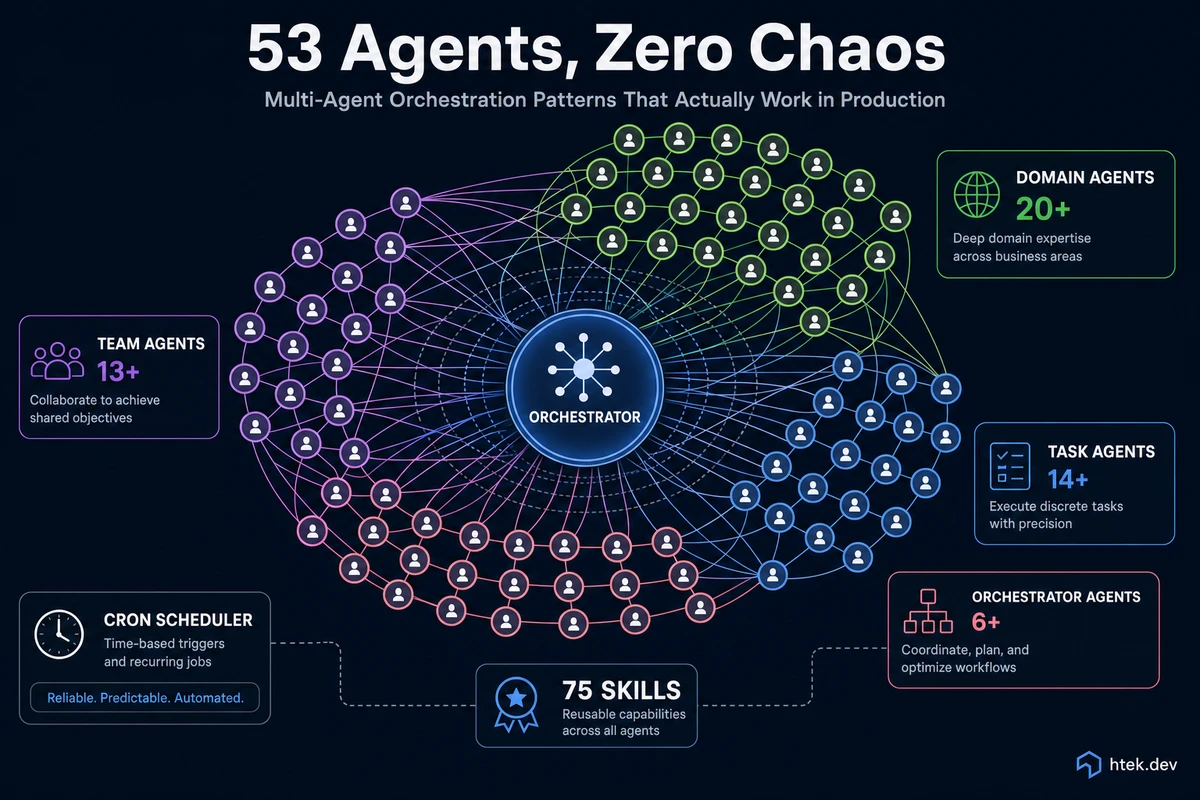
Everyone’s talking about multi-agent systems in 2026. Most demos show 3 chatbots in a loop. Here’s what a real 53-agent system looks like after 6 months of daily production use.
I run 53 specialized AI agents, 75 reusable skills, and a cron-driven scheduling system — all orchestrated through GitHub Copilot CLI. Not as a demo. Not as a weekend project. As the production infrastructure that runs my family’s daily life and my entire content operation.
This post is the 10,000-foot view. The full configs, state machines, and protocols are in Newsletter Issue #6.
The Problem Nobody Talks About
Building one AI agent is easy. Building fifty-three that don’t overlap, lose context, or spam you at 3 AM is a different engineering problem entirely.
The multi-agent orchestration landscape in 2026 is full of frameworks promising coordination. They solve wiring. They skip the harder questions: scheduling, overlap prevention, and failure handling.
I’ve written about parts of this system before — memory, skills, MCP patterns, and extensions/hooks. This post ties them together: the orchestration patterns that make 53 agents work as a system, not a crowd.
Four Agent Patterns (Not One)
Most frameworks treat every agent like the same prompt-with-tools abstraction. In production, I need four patterns with different lifecycle rules and memory requirements.
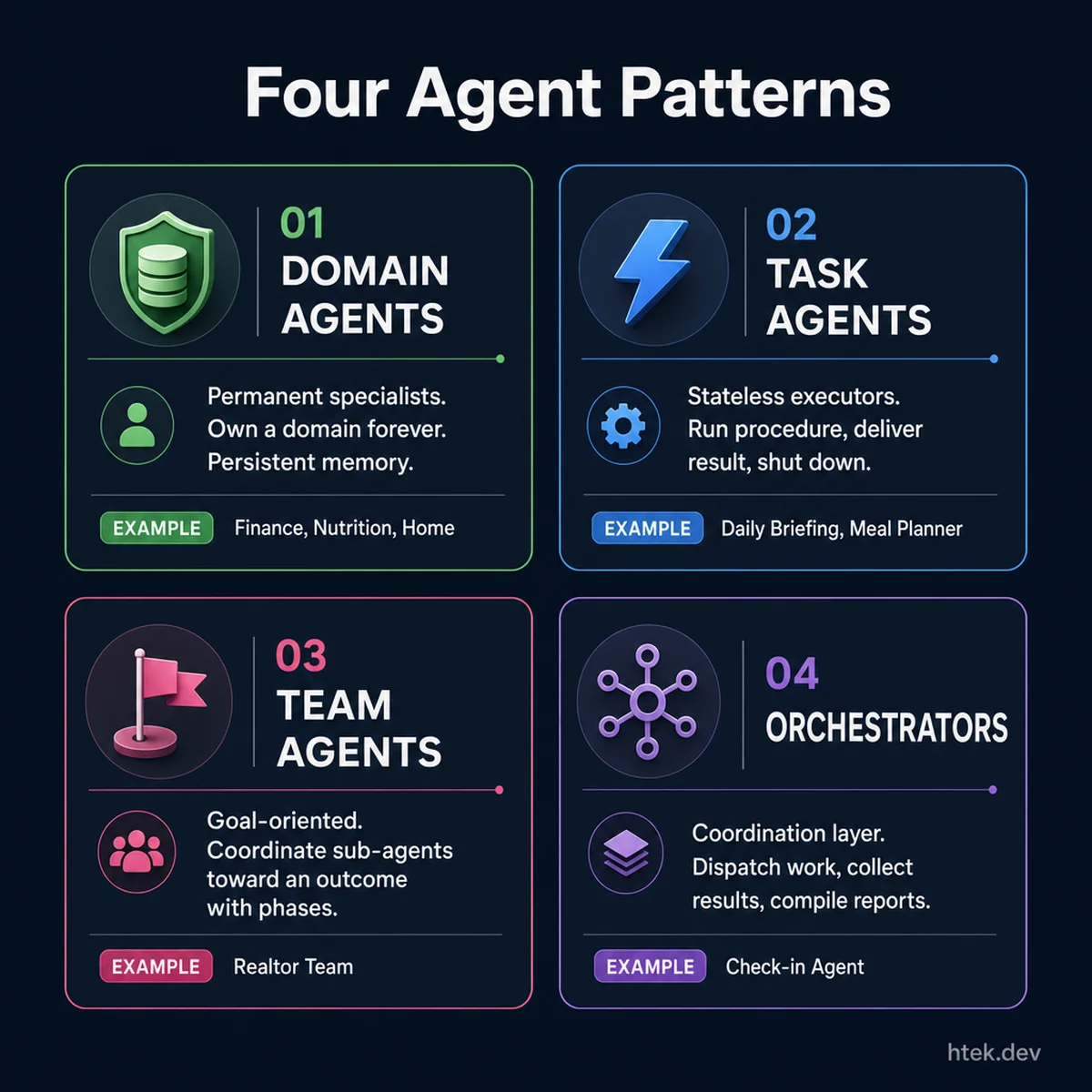 The four agent patterns — each with different lifecycle rules, memory tiers, and responsibilities.
Pattern 1: Domain Agents
These are permanent specialists. A finance manager that tracks bills and budgets. A nutrition chef that tracks dietary preferences and grocery lists. A home maintenance agent that schedules repairs. Each one owns a specific domain, has persistent 4-tier memory, and runs for the lifetime of the platform.
I have 20+ domain agents. They don’t orchestrate anything — they’re experts in their lane.
Pattern 2: Task Agents
Stateless executors. A daily briefing agent that compiles weather, calendar, tasks, and email into one morning message. A meal planner that fires every Saturday to ask what I’m cooking. They run a procedure, deliver a result, and shut down.
Pattern 3: Orchestrators
The coordination layer. Orchestrators dispatch work to domain agents, collect results, and compile a single report.
Pattern 4: Team Agents
This is the pattern nobody talks about. A team agent represents a goal, not a domain. It coordinates a fixed group of sub-agents toward an outcome — like buying a house — with phases, milestones, exit criteria, and an end state.
The Cron Architecture
Here’s where most multi-agent systems fall apart: scheduling.
If you’re triggering agents manually, you have a toy. Production agents need schedules — morning briefings, bill reminders, content checks. My system uses a cron.json file that maps schedules to agent dispatches, with one critical rule: every cron dispatch gets a fresh agent. No reusing idle sessions. No injecting messages into running agents.
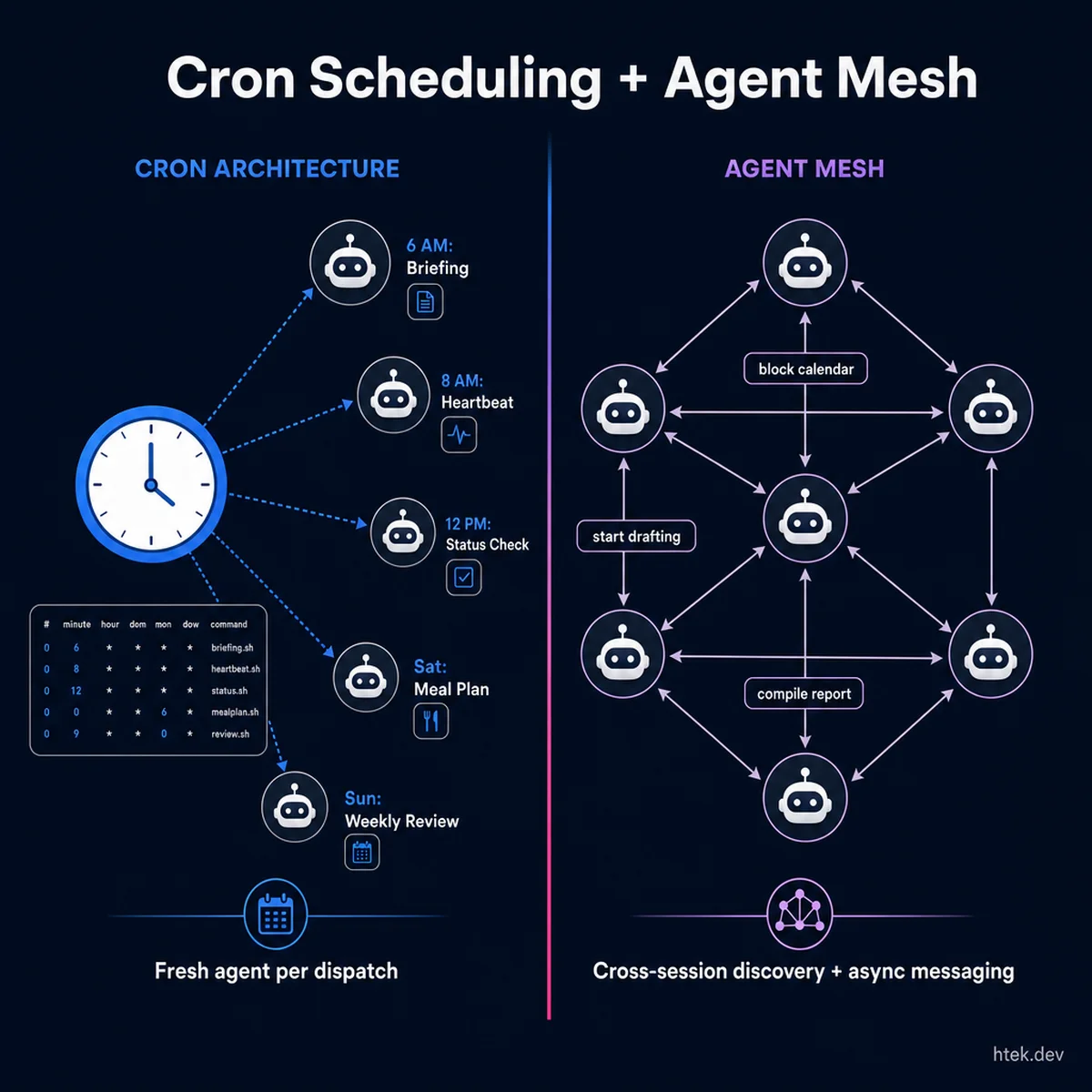 Left: Cron-driven scheduling dispatches fresh agents on predictable schedules. Right: The agent mesh enables cross-session discovery and async messaging.
The Agent Mesh
53 isolated agents are useless if they can’t communicate. The agent mesh is a lightweight cross-session protocol that lets agents in different GitHub Copilot CLI sessions discover each other and exchange messages asynchronously. A personal agent can tell a work agent to block calendar time; a content manager can tell a writer to start drafting.
Skills: The Scaling Mechanism
At 53 agents, you can’t afford inline logic in every instruction file. Skills are reusable procedure files (.github/skills/{name}/SKILL.md) that any agent can reference. I have 75 of them covering Telegram communication formatting, brand safety checks, and calendar availability logic. Update a skill once, and every dependent agent gets it.
This is the same pattern Microsoft shipped with Copilot agent skills — but I was building it months before the official feature landed. The convergence validated the architecture.
What Does This Look Like Day-to-Day?
At 6 AM, a cron job fires my daily briefing agent — it merges two calendars, scans emails, pulls today’s tasks, and sends one Telegram message with everything I need. Throughout the day, a heartbeat agent handles email triage, calendar reminders, and task nudges. When I mark a task done, the next one appears immediately. One at a time, no decision fatigue.
The system even generates tasks proactively — a doctor appointment tomorrow triggers “grab insurance cards” and “leave by 9:30 AM” automatically. Event-driven prep, not manual checklists.
The Patterns That Actually Matter
After six months, here’s what I’ve learned matters most for production multi-agent orchestration:
- Agent isolation — Every agent gets its own context window. Shared state is explicit, never implicit.
- Typed agent patterns — Not all agents are the same. Domain, Task, Orchestrator, and Team patterns have different rules.
- Cron-driven scheduling — Agents run on schedules, not just triggers. This is non-negotiable for production.
- Skills over inline logic — Extractable, reusable procedures beat copy-pasted instructions every time.
- Communication protocol — Agents need to talk to each other, but through a defined mesh, not spaghetti message passing.
- Memory tiers — Not every agent needs persistent memory. Match the tier to the pattern. (More on this in the memory deep dive.)
These aren’t theoretical. They’re battle-tested across 53 agents running daily for six months. The convergent architecture I described in The Convergent Architecture shows up elsewhere too — Stripe and Coinbase reached similar patterns independently.
Go Deeper
This was the 10,000-foot view. Newsletter Issue #6 has the full state machines, cron architecture, agent mesh protocol, and configs.
Subscribe at htek.dev/newsletter →
For a step-by-step implementation guide, see the 4-Tier Agent Memory System Blueprint and the Agentic Development Blueprint.
This is Part 5 of the Content Blitz series. Previous posts: Day 1 — Context Engineering, Day 2 — Agent Skills, Day 3 — MCP Patterns, Day 4 — Three Missing Layers.