The Graph Nobody Draws
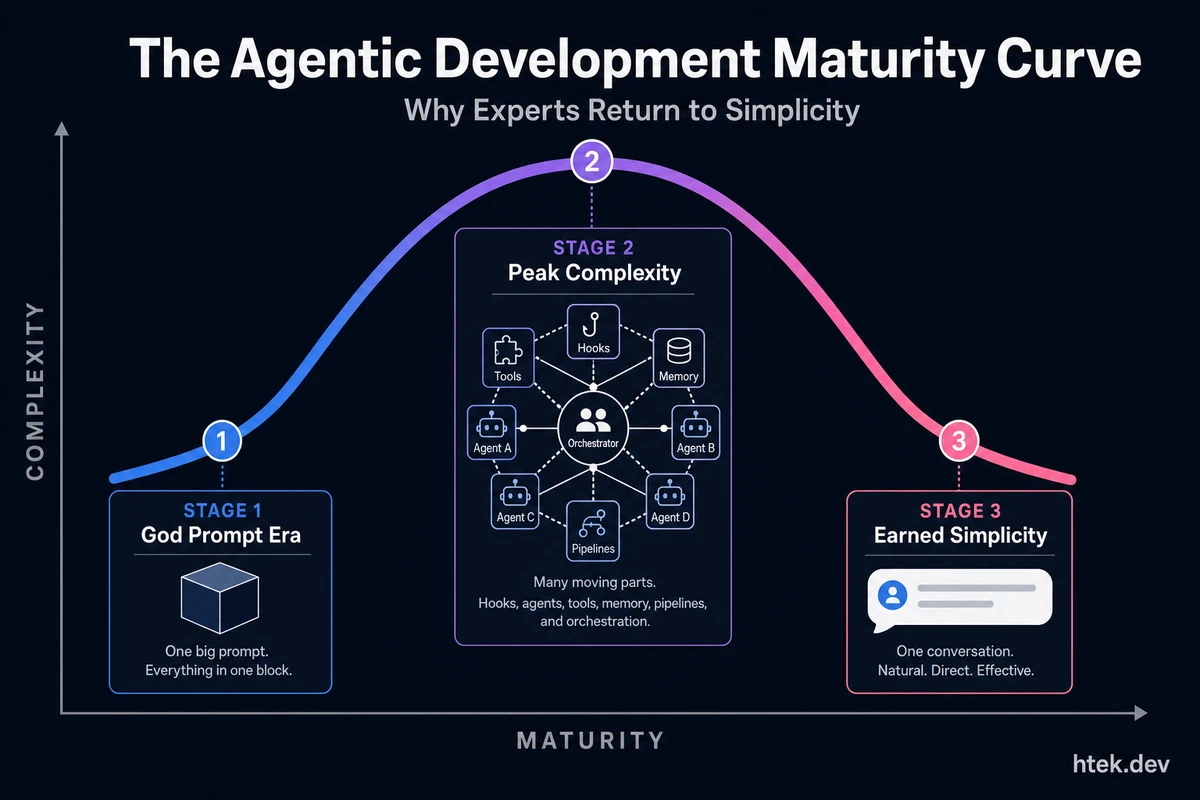
There’s a pattern I keep seeing in agentic development that almost nobody talks about. It looks like an inverted U:
Complexity
    │
    │         ╭──────╮
    │        ╱        ╲
    │       ╱          ╲
    │      ╱            ╲
    │     ╱              ╲
    │    ╱                ╲
    │───╱                  ╲───
    │
    └───────────────────────────→ Maturity
       Stage 1    Stage 2    Stage 3
       "Build me   "Multi-agent  "Just talk
        an app"    orchestration"  to it"
Stage 1: Low maturity, low complexity. You throw one big prompt at an agent. “Build me an app.” That’s what you think agentic coding is.
Stage 2: Mid maturity, HIGH complexity. Multiple agents, hooks, hookflows, governance patterns, test-driven development with agents, skill extraction, orchestration layers. Everything is meticulously organized.
Stage 3: High maturity, LOW complexity. You go back to simple prompts and one agent. That’s all you need. Simple planning, simple executing, proper steering.
I saw this concept articulated perfectly in Peter Steinberger’s conversation with Lex Fridman about agentic engineering. Steinberger — creator of OpenClaw — described essentially this same curve. His blog post title says it all: “Just Talk To It.”
It hit me because I’ve lived all three stages. And the insight that changed my workflow isn’t a new framework or tool — it’s the realization that the simplicity on the other side of complexity is earned, not lazy.
Stage 1: The God Prompt Era
When I started with agentic coding, I did what everyone does. I tried to spec out an entire application in one massive prompt. 2,000 words of requirements, architecture decisions, and implementation details — all jammed into a single message.
I’ve written about this anti-pattern before. The god prompt is the new monolith. It felt productive because you were being “thorough.” In reality, you were overwhelming the agent with conflicting instructions and getting mediocre results.
Most developers stay here for a while. They conclude that “AI coding doesn’t really work” and go back to writing everything by hand. They never see what’s on the other side.
Stage 2: The Complexity Peak
Once I got past the god prompt phase, I went deep. I’m talking:
-
Test-driven development with agents — writing comprehensive test suites first, then letting agents implement against them. I wrote about this in Tests Are Everything in Agentic AI and it works incredibly well for ensuring correctness.
-
Agent hooks — filesystem-level governance that intercepts agent operations before they execute. I built hook-based systems to enforce architecture boundaries, mock policies, and layer rules.
-
Hookflows — multi-step validation pipelines that chain hooks together for complex governance. Pre-commit checks, lint enforcement, automated review gates.
-
Multi-agent orchestration — dedicated agents for different domains, each with their own memory, skills, and communication protocols. I open-sourced the home assistant that runs my family’s entire life: 17+ agents, 16 extensions, 15 cron jobs, all coordinated through an agent mesh.
-
The Research → Plan → Implement pipeline — a structured anti-vibe-coding workflow with explicit human review gates between phases.
-
Skill extraction — identifying repeatable agent capabilities and extracting them into portable, testable, composable skills that any agent can invoke.
Every one of these techniques is valid. They solve real problems. TDD catches hallucinations. Hooks prevent architecture violations. Multi-agent patterns enable genuine specialization. I stand by all of it.
But here’s what nobody tells you: this is the peak of the complexity curve, not the destination.
Stage 3: Earned Simplicity
Here’s where I am now for actual software development work: I open GitHub Copilot, write a simple prompt, and let the agent plan and execute. That’s it.
No elaborate hook chains. No multi-agent orchestration for a single feature. No 47-step governance pipeline. Just:
- Clear, simple prompt — what I want, why, and any critical constraints
- Let the agent plan — review its approach, steer if needed
- Let it execute — monitor, course-correct, done
Peter Steinberger describes the same thing. He runs 3–8 parallel agent instances with simple prompts — the principle holds regardless of which tool you choose. No complex hook systems. He thinks about “blast radius” — how big the change is — and adjusts his prompts accordingly. When something goes sideways, he just stops and says “what’s the status.”
The key insight: this simplicity only works because of what you learned in Stage 2. You internalized the mental models. You know:
- When to break a task into smaller pieces (blast radius thinking)
- How to write prompts that prevent common failure modes
- When to stop the agent and course-correct vs. letting it finish
- What “good enough” context looks like without over-engineering it
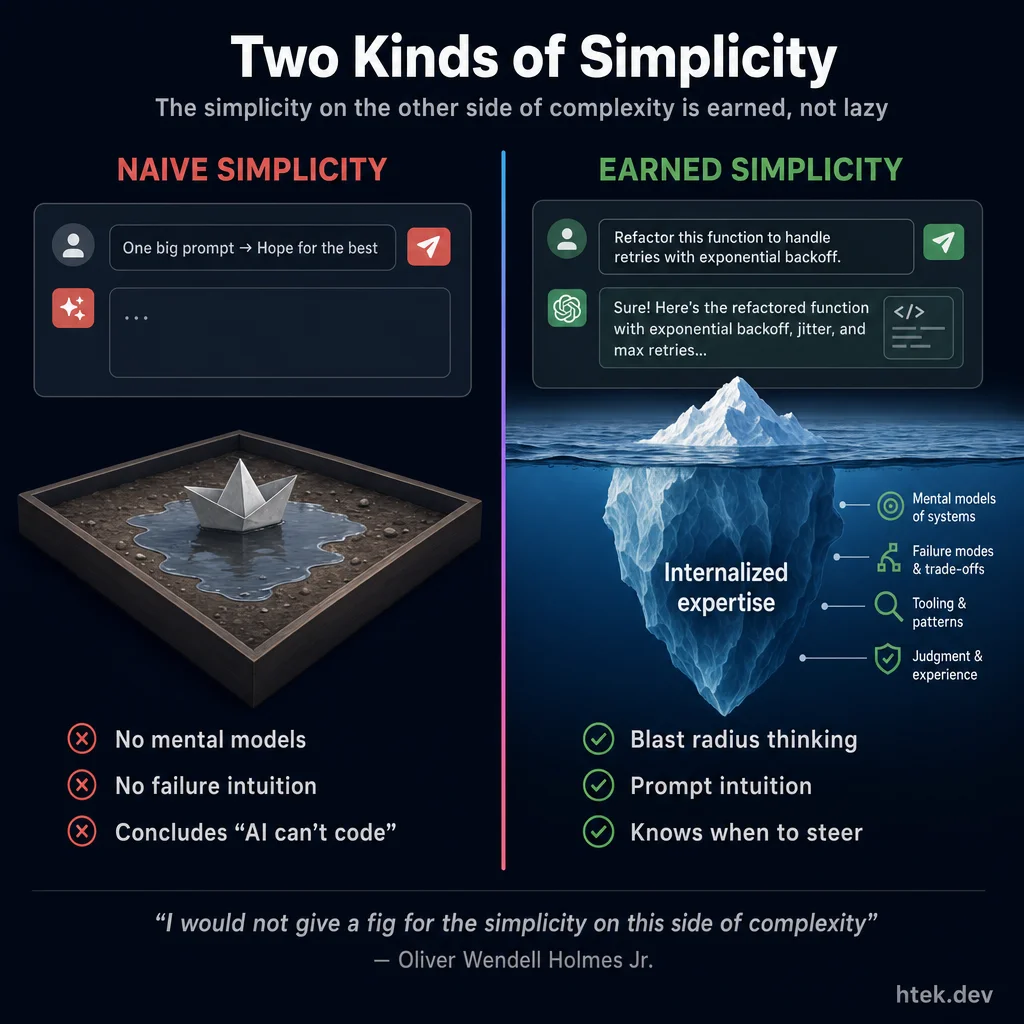 The simplicity on the other side of complexity is earned, not lazy — the invisible difference is internalized expertise.
This is what Oliver Wendell Holmes Jr. famously expressed: “I would not give a fig for the simplicity on this side of complexity, but I would give my life for the simplicity on the other side of complexity.”
The Crucial Distinction: Form Factor Matters
One thing I need to be clear about: there are legitimate use cases for Stage 2 complexity. My home assistant platform — with its multi-agent orchestration, cron jobs, and governance layers — is genuinely complex. And it should be. It’s a persistent assistant managing a family’s daily life. Different form factor, different requirements.
But for software development workflows — writing features, fixing bugs, building applications — high maturity means returning to simplicity. The agent is your pair programmer, not a Rube Goldberg machine.
The same principle applies in traditional software engineering. Junior developers write complex code because they don’t know better. Senior developers write simple code because they’ve earned it. Context engineering matters more than prompt engineering — knowing what to feed the agent is more valuable than knowing how to construct elaborate instruction sets.
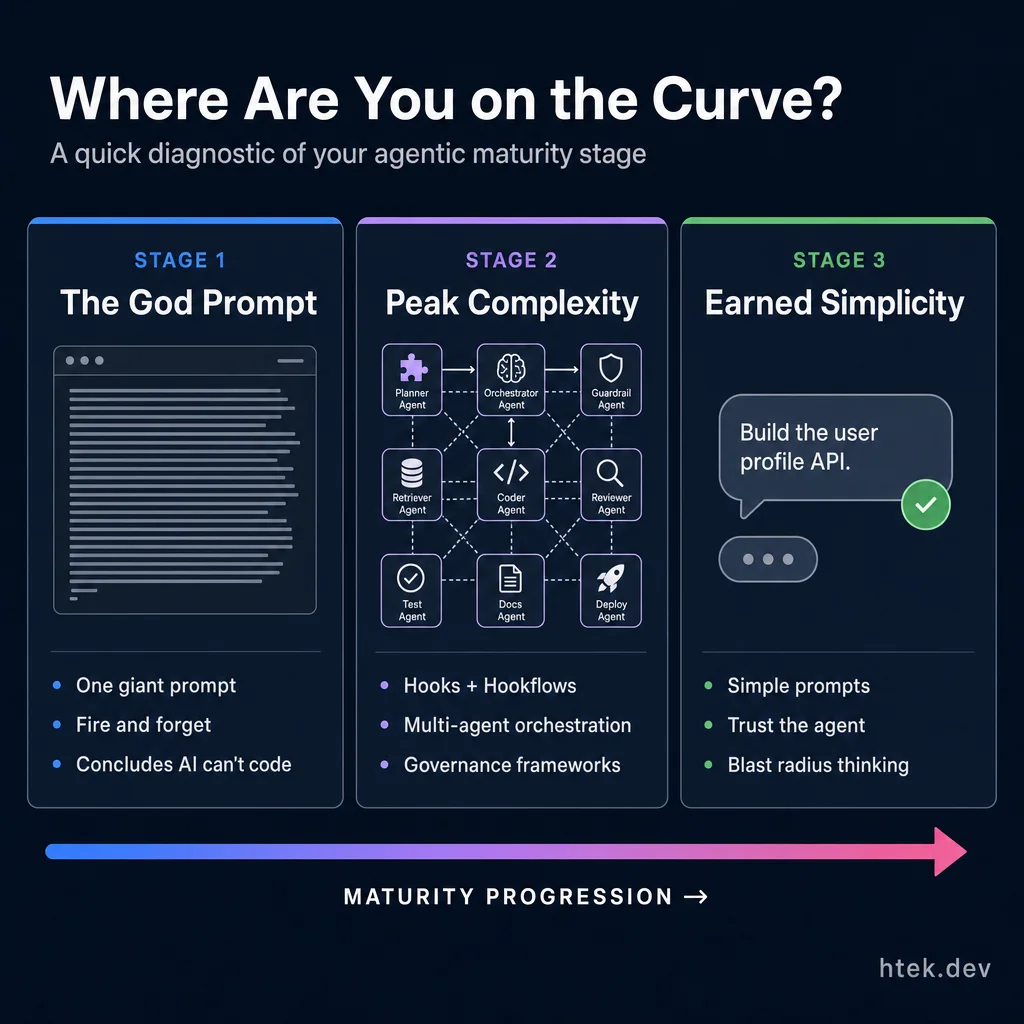 A quick diagnostic: which stage describes your current agentic development workflow?
Where Are You on the Curve?
Here’s a quick diagnostic:
You’re in Stage 1 if:
- You write one massive prompt and expect a complete application
- You think “AI can’t code” because your mega-prompts produce garbage
- You haven’t tried iterative agent steering — just fire-and-forget
You’re in Stage 2 if:
- You have elaborate governance frameworks around your agents
- You spend more time configuring agent infrastructure than building features
- You feel like you need 5+ agents and hooks for every project
- Your agent workflow has more moving parts than the code it produces
You’re in Stage 3 if:
- You use hooks sparingly — to augment, not as the core workflow
- You trust simple prompts because you know how to write them well
- You think in terms of “blast radius” before deciding task granularity
- Your agent interactions look like conversations with a skilled colleague
- You only reach for complex orchestration when the problem domain demands it
How to Accelerate Through Stage 2
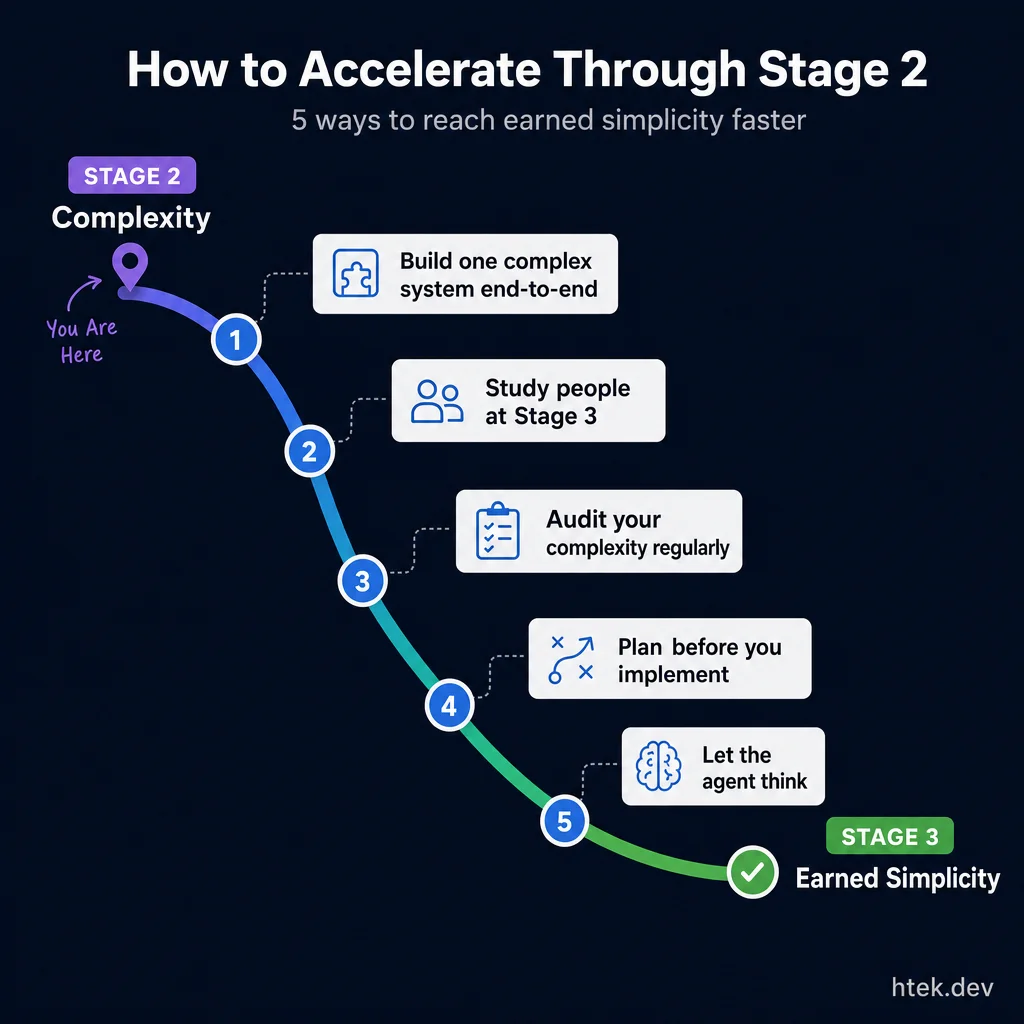 Five stepping stones that help you move through the complexity peak faster and reach earned simplicity.
You can’t skip Stage 2, but you can move through it faster:
-
Build one complex system end-to-end. TDD with agents, hooks, multi-agent — learn what each technique actually solves. Then you’ll know when you don’t need them.
-
Study people at Stage 3. Watch how Steinberger works. Notice what’s absent from their workflows. The tools they don’t use tell you more than the tools they do.
-
Audit your complexity regularly. Ask: “Is this hook solving a real problem, or am I over-engineering because I can?” If your governance layer is more complex than your application logic, you’ve over-indexed.
-
Plan before you implement. The anti-vibe-coding workflow still applies — but at Stage 3, the “plan” is a 3-sentence description, not a 40-page spec. The discipline is internalized.
-
Let the agent think. Plan mode exists for a reason. Simple prompt + agent planning = surprisingly good results without elaborate scaffolding.
The Bottom Line
The maturity curve for agentic development isn’t a straight line toward more complexity. It’s an inverted U. The developers getting the most out of AI agents today aren’t the ones with the most elaborate orchestration systems — they’re the ones who went through that phase and came out the other side.
Mastery in agentic development looks deceptively like what beginners do: simple prompts, one agent, clear communication. The difference is invisible — it lives in the mental models, the prompt intuition, and the earned judgment about when complexity actually serves you.
If you’re deep in Stage 2 right now, building hooks and multi-agent systems and governance frameworks — that’s good. You’re learning. Just don’t mistake the peak of complexity for the summit of mastery. The summit is simpler than you think.
Want this done for you? I build production apps using these exact agentic workflows — delivered in days, not months. See my rapid app development services →