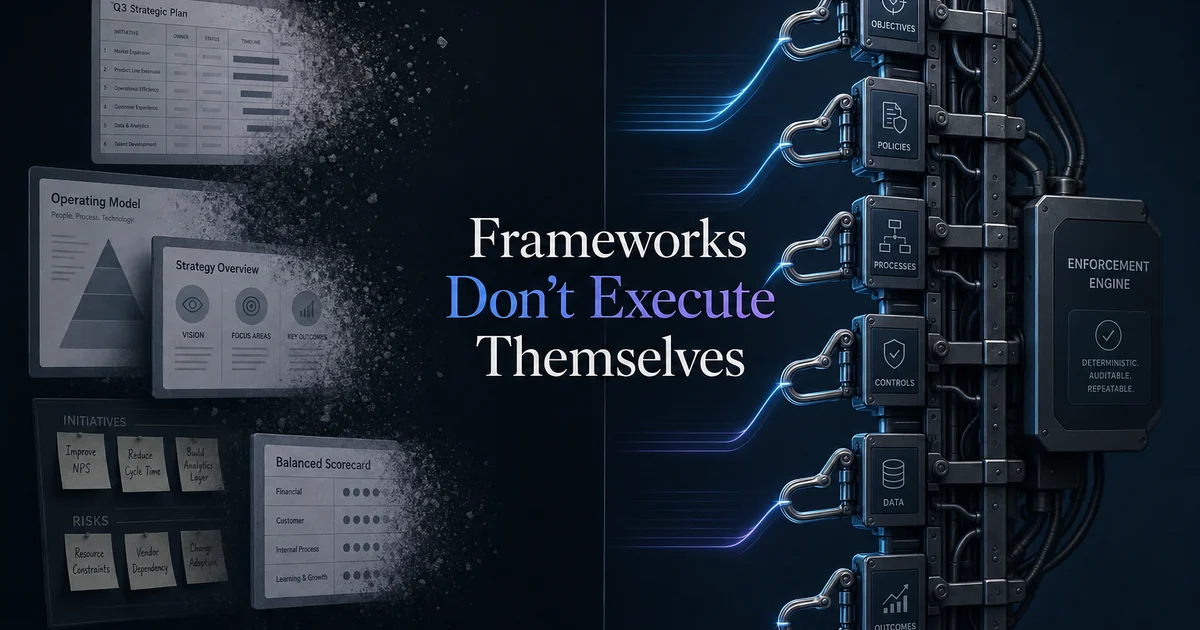
The Wednesday Problem
Here’s a pattern I’ve seen destroy more organizational initiatives than bad strategy ever could: Monday energy dies by Wednesday.
Your team runs an offsite. Everyone’s inspired. The consultant delivers a gorgeous deck — ExO attributes, OKR cascades, EOS rocks, Agile ceremonies. Heads nod. Post-its cover whiteboards. The energy is real. By Wednesday, three Slack threads have pulled focus. By month two, the scorecards are half-updated. By month three, the slides are a shared drive artifact nobody opens.
This isn’t a discipline problem. It’s an architecture problem.
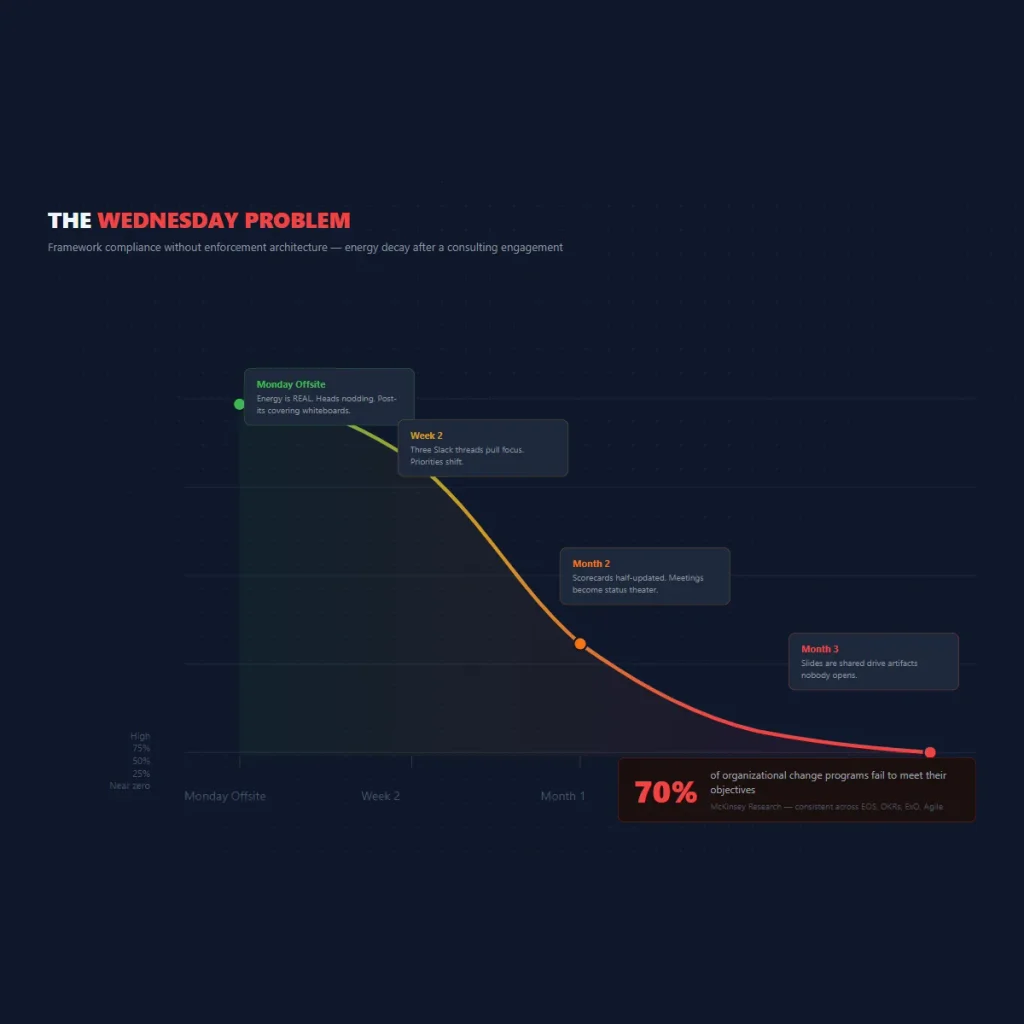 The Wednesday Problem: organizational energy decays predictably from Monday inspiration to Month 3 abandonment.
McKinsey’s oft-cited research estimates that 70% of organizational change programs fail to meet their objectives. Not 30%. Not half. Seventy percent. And this isn’t because people lack commitment or the frameworks are intellectually flawed. It’s because every single one of these frameworks has the same fatal gap: they tell you WHAT to do, with zero mechanism to ensure you actually do it.
The Framework Graveyard
Let’s be specific about what fails and why.
EOS: The $60K Spreadsheet
The Entrepreneurial Operating System promises simplicity: rocks, scorecards, Level 10 meetings, accountability charts. Thousands of companies implement it. A typical consulting engagement runs $60,000+, takes 18-36 months, and by most accounts, the majority of implementations stall or partially fail once the implementer stops showing up.
The typical post-mortem? Beautifully designed spreadsheets that were completely worthless three months after the implementer left. The accountability chart existed. People just stopped looking at it. The rocks were set. Nobody checked the scorecard. The Level 10 meeting happened — but became a status theater where “discuss” replaced “resolve.”
EOS’s defense is always the same: “You didn’t follow the process purely enough.” But that’s the point. Any system that requires perfect human compliance to function isn’t a system — it’s a suggestion.
ExO: Aspirational Pillars, No Hooks
Salim Ismail’s Exponential Organizations framework is intellectually compelling. The SCALE and IDEAS attributes map real patterns behind companies that achieve 10x growth. The Massive Transformative Purpose concept is genuinely useful. ExO 2.0 adds governance language — “Govern/Assure” shows up as a principle.
But show me the enforcement mechanism. Show me the deterministic gate that fires when someone violates the operating model. Show me the hook that prevents an autonomous process from drifting. You won’t find it — because it doesn’t exist. ExO tells you to have governance. It never tells you how to enforce it computationally.
The ExO Sprint produces “mindset shifts” and “transformation roadmaps.” Participants report feeling inspired. But inspiration without enforcement is just a more expensive version of a TED talk.
OKRs: Measuring Drift, Not Preventing It
OKRs at least acknowledge measurement. But they measure outcomes after the fact. By the time your key result shows you’ve drifted, you’ve already drifted. It’s a lagging indicator system applied to a problem that demands leading enforcement. A Journal of Business Research study on digital transformation found the same pattern across industries — failure rates remain stubbornly high because measurement without enforcement is observation, not control.
I’d argue Google made OKRs work because Google already had engineering systems enforcing operational discipline computationally — code review gates, deployment pipelines, automated testing. The OKRs weren’t the system. The engineering infrastructure was. OKRs just gave humans a way to talk about what the machines were already enforcing.
The Core Distinction: Frameworks vs. Systems
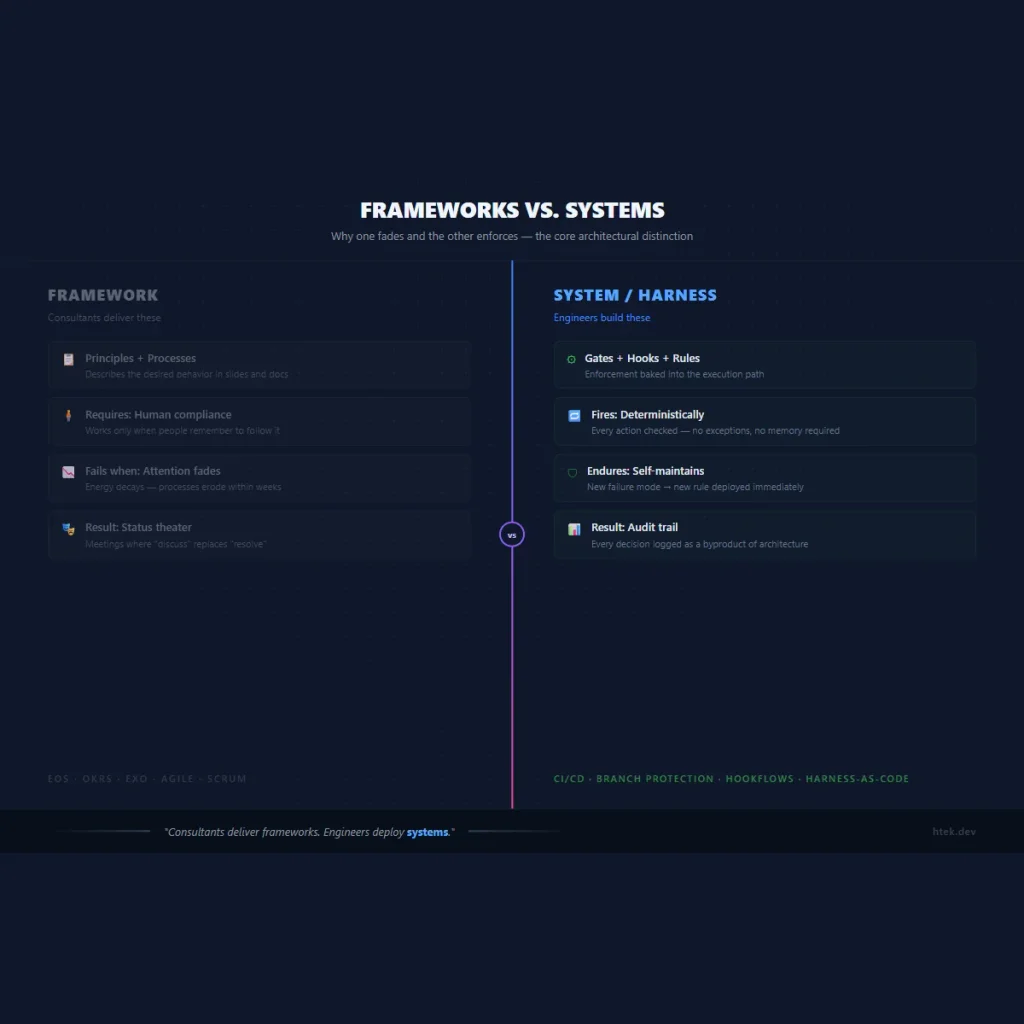 Consultants deliver frameworks. Engineers deploy systems. The difference is enforcement.
Here’s what none of these approaches acknowledge:
Consultants deliver frameworks. Engineers deliver systems.
A framework is a set of principles, patterns, and processes that humans are expected to follow through willpower and organizational pressure. A system is infrastructure that makes certain behaviors deterministic — they happen whether anyone remembers to do them or not.
Your CI/CD pipeline doesn’t suggest running tests before deploy. It gates deployment behind passing tests. Your branch protection rules don’t recommend code review. They block merges until review is approved. These aren’t frameworks. They’re enforcement architectures.
The transformation industry sells frameworks because frameworks require ongoing consulting. Systems, once built, maintain themselves.
What Enforcement Actually Looks Like
I run 53 autonomous AI agents in production. They manage finances, schedule appointments, publish content, coordinate family logistics — real operations with real consequences. They’ve been running for six months with zero governance incidents.
Not because my agents are simple. Not because they follow a framework. Because they’re wrapped in a harness — a declarative governance layer that fires deterministically on every single tool call.
Here’s what that means concretely:
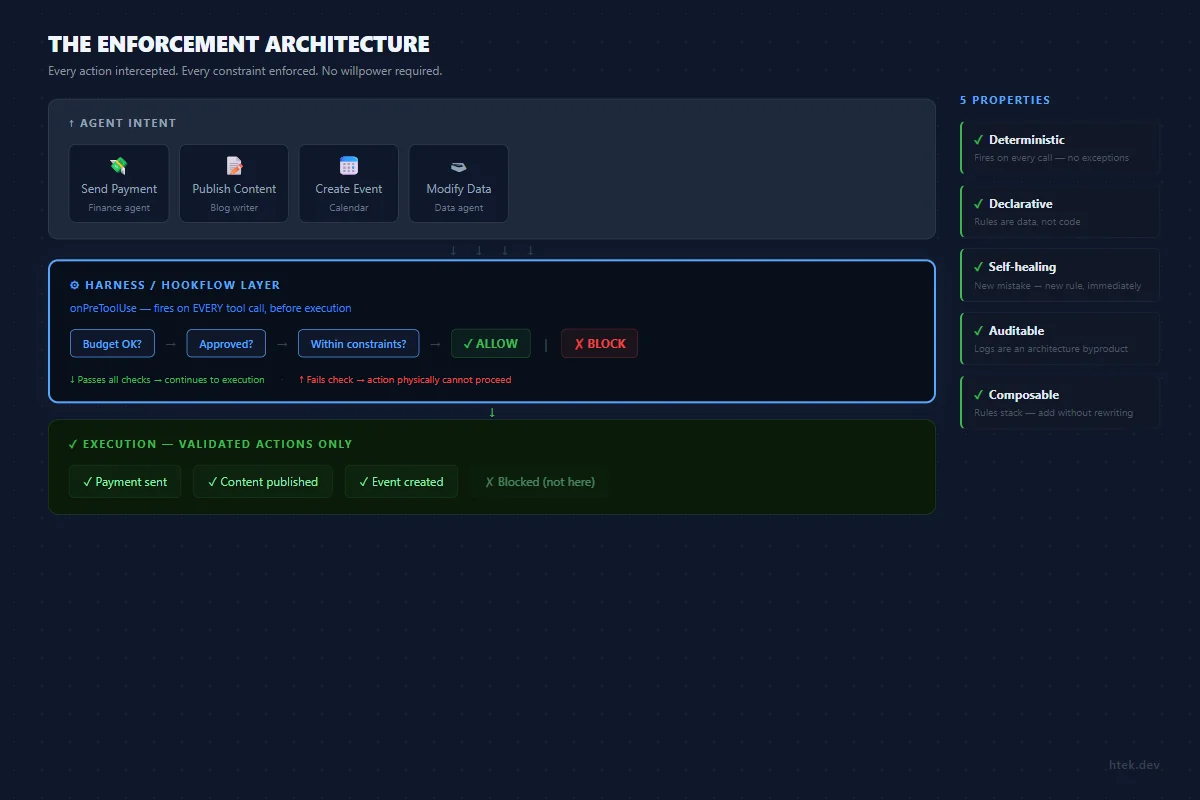 Deterministic enforcement: every action passes through the hookflow gate. No willpower required — the gate is computational, not cultural.
Hookflows fire on every action. When an agent attempts any operation — sending money, creating an event, publishing content — a hookflow intercepts it pre-execution. The hookflow checks: Does this violate a constraint? Is this within budget? Does this need approval? If the answer is “block,” the action physically cannot proceed. No willpower required. No accountability meeting needed. The gate is computational, not cultural.
Governance is code, not slides. My governance rules live in version-controlled files — YAML hookflows, markdown rules, extension handlers. They get pull requests, code review, and automated testing just like application code. When I identify a new failure mode, I don’t update a policy document and hope people read it. I write a hookflow rule that makes the failure impossible.
The system self-maintains. When an agent makes a mistake, the platform’s response isn’t “schedule a retrospective.” It’s: write a hookflow that prevents this class of mistake permanently, deploy it immediately, verify it catches the pattern. The gap between identifying a problem and enforcing its solution is minutes, not quarters.
You Don’t Need a Framework — You Need a Harness
A harness is what happens when you apply engineering rigor to operational governance. It’s the infrastructure layer that sits between intent and execution, ensuring that every action passes through deterministic validation before it touches reality.
The key properties that make a harness work where frameworks fail:
- Deterministic — Rules fire on every invocation. No “forgot to check the scorecard” because the scorecard is the gate.
- Declarative — Governance is defined as data, not embedded in implementation. Change the rule file, change the behavior across all agents instantly.
- Self-healing — When a new failure mode appears, the operating loop writes a new enforcement rule. The immune system strengthens with every correction.
- Auditable — Every decision, every gate evaluation, every override is logged. Not because someone remembers to write it down — because the architecture produces the audit trail as a byproduct.
- Composable — Rules stack. New constraints layer onto existing ones without rewriting the system. Add a financial approval gate without touching the scheduling governance.
This is what ExO means when it says “Govern/Assure” — but implemented as actual running code instead of a slide with a pillar diagram.
The Forward Deployed Engineer
The transformation industry is full of consultants who deliver frameworks. It needs more engineers who deploy systems.
Palantir popularized the “Forward Deployed Engineer” concept — engineers embedded directly in client operations rather than advising from headquarters. I’m applying the same principle to governance infrastructure: not advising from the outside, but deploying enforcement architecture directly into your operation. The difference between “here’s a governance framework” and “here’s a running system that prevents policy violations computationally” is the difference between a diet book and a locked refrigerator.
The organizations that will actually transform aren’t the ones with the best frameworks. They’re the ones that figured out: governance is an engineering problem, not a management problem. And engineering problems get engineering solutions — deterministic, automated, and self-maintaining.
The Bottom Line
If you’ve tried EOS, ExO, OKRs, Agile, or any combination — and found that the energy always fades, the process always erodes, and you always end up back where you started — it’s not you. It’s the architecture. You were given a framework when you needed a harness.
Frameworks describe the world you want. Harnesses enforce it.
If your operation runs on frameworks that die between meetings, the problem isn’t discipline. It’s that you’re solving an engineering problem with a management tool. I build harnesses that enforce themselves — deterministic governance deployed directly into operational infrastructure. Let’s talk about what that looks like for your operation.