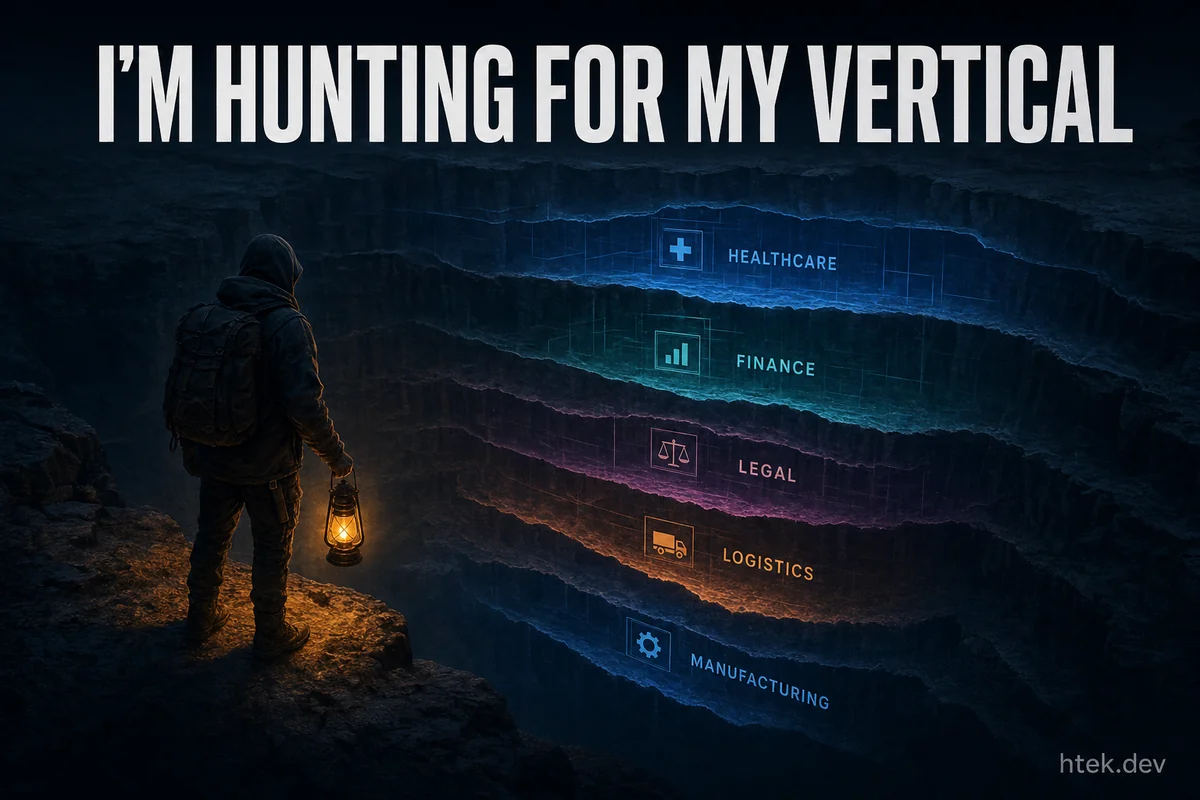
One week. Five industries. One discovery that changed how I think about the next decade of software.
I built an agentic financial advisor, a legal advisor, a marketing tool, a scheduling assistant, and a medical workflow tool. Each was AI-powered. Each was genuinely useful. Each took me a few days to build.
The part that unsettled me wasn’t how fast I could build. It was what the pattern meant.
Every vertical had a completely different character — its own compliance structure, its own procedural data, its own relationship dynamics. The more I understood a specific vertical’s inner workings, the more powerful the AI outputs became. Conversely, the moment I built something generic — something for “everyone” — the value diluted immediately.
The moat isn’t in the model. It isn’t in the framework. It isn’t even in how fast you can ship.
The moat is the vertical.
The Floor Has Dropped Out
Before we talk about why verticals win, we need to be clear about what they’re winning against.
Jensen Huang said it plainly on the All-In Podcast this year: the competitive advantage in the AI era is no longer which model you run or how fast you can build. It’s the vertical knowledge you bring to it. The moat is knowing more about a specific domain than anyone else and using AI to compound that knowledge gap.
Nikesh Arora, CEO of Palo Alto Networks, went further on the All-In Podcast this week: analytical SaaS is structurally dead. His argument: analytics companies exist to compress and synthesize context. That is exactly what any capable model does now, in seconds. The entire business model of “take in data, analyze it, give you something synthesized” has been replicated for free by any developer with a decent API key.
I’ve built those tools myself. Not as products — almost subconsciously, as a side effect of exploring an idea. The floor for horizontal software capability has dropped out.
a16z called it a moat migration last December: the moats haven’t disappeared, but they’ve moved. Off the platform layer. Into the domain layer. Activant Capital framed it simply in their February 2025 analysis: the industry context that used to be a feature is now the product itself.
Horizontal capability is not the moat anymore. It is the price of entry.
Why Verticals Win
During my week of building across five industries, one engagement hit differently. I was working on a medical device servicing application — the kind of tool that tracks maintenance procedures, compliance documentation, and field technician workflows for hospital equipment.
What I found was a textbook example of why vertical depth creates defensible moats that horizontal tools can’t touch.
Compliance power. Hospitals make massive investments in medical devices. Once you’re qualified to service that equipment — once you’re in their system, accredited, embedded in their workflow — switching is genuinely hard. Add AI that learns their specific device fleet, their procedure history, their technician notes? The moat deepens with every service call. The longer you’re in, the more structurally irreplaceable you become.
Proprietary data. Medical devices run on ancient technology, but they’re extraordinarily verbose. Specs, error codes, procedure manuals, maintenance logs — it’s all procedural, structured, richly contextual. No generic inventory app has this data. A purpose-built vertical application that accumulates it over years is in a different category entirely. Euclid Ventures describes this as the layer commoditization cycle inverting: vertical players who own deep domain data become more valuable as the horizontal layer commoditizes.
Relationships and infrastructure. The relationship a medical device service company has with a hospital isn’t just commercial — it’s operational. Field techs know the equipment. Schedulers know the facilities manager. AI layered into those workflows doesn’t just make things faster; it makes the relationship stickier. You’re not selling software anymore. You’re part of the hospital’s operational continuity.
This pattern exists in every high-relationship, high-compliance vertical: construction, energy, legal, logistics. The specifics change. The structure doesn’t. Generic tools exist for all of them. ServiceBridge handles field service dispatch for general contractors. Generic inventory apps cover dozens of verticals. But “general” is not “deep.” A tool built for the medical device servicing vertical — one that knows the specific procedural documentation, compliance requirements, and switching costs of that niche — isn’t ServiceBridge. It’s something that only gets built by someone who went truly, irreversibly deep.
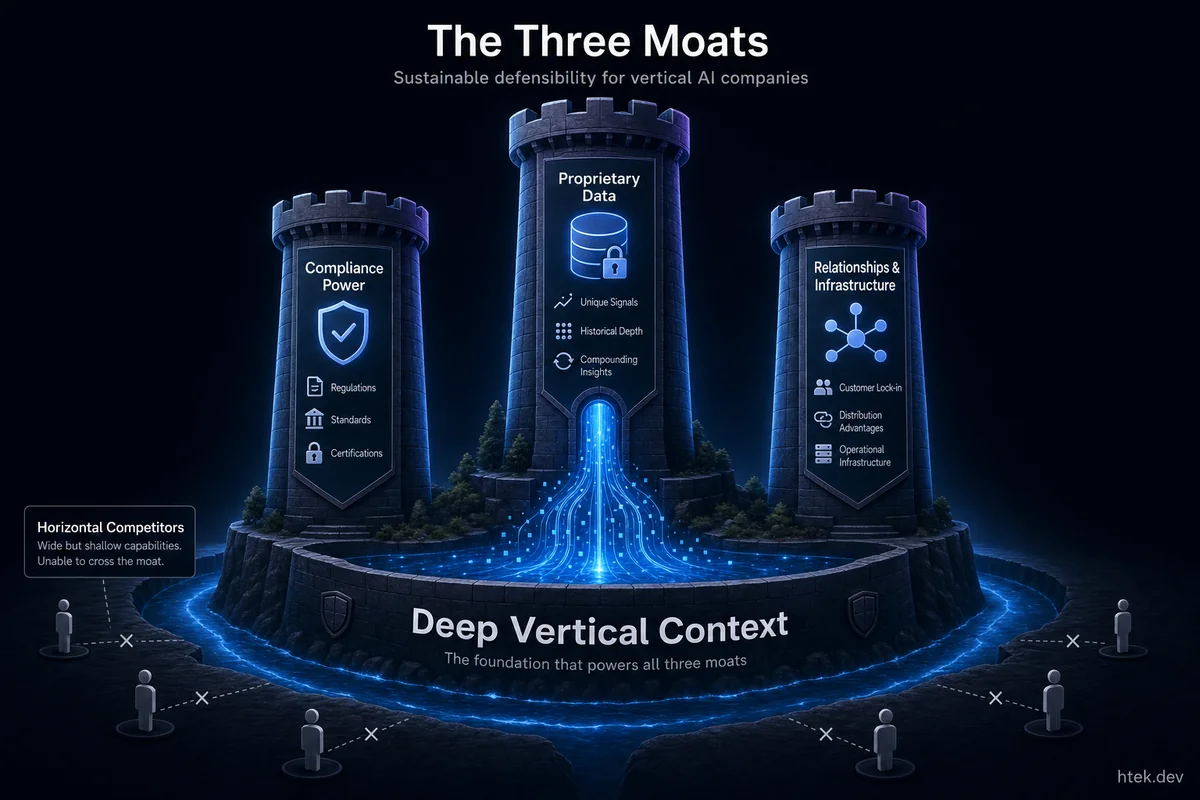 The three moats generic AI tools can’t replicate: compliance power, proprietary data, and operational relationships — all compounded through accumulated vertical depth.
The Context Payoff
Here’s what nobody talks about: when you go deep enough into a vertical, something remarkable happens. Your accumulated domain knowledge becomes a structural weapon that no generalist can replicate.
The ability to build software is no longer a strong asset.
Being able to execute a workflow is no longer a strong asset.
Knowing what workflow to execute is the strong asset.
Knowing what context to bring in is the asset.
The context is the asset. But here’s the key: the context doesn’t exist in isolation. It flows from the vertical.
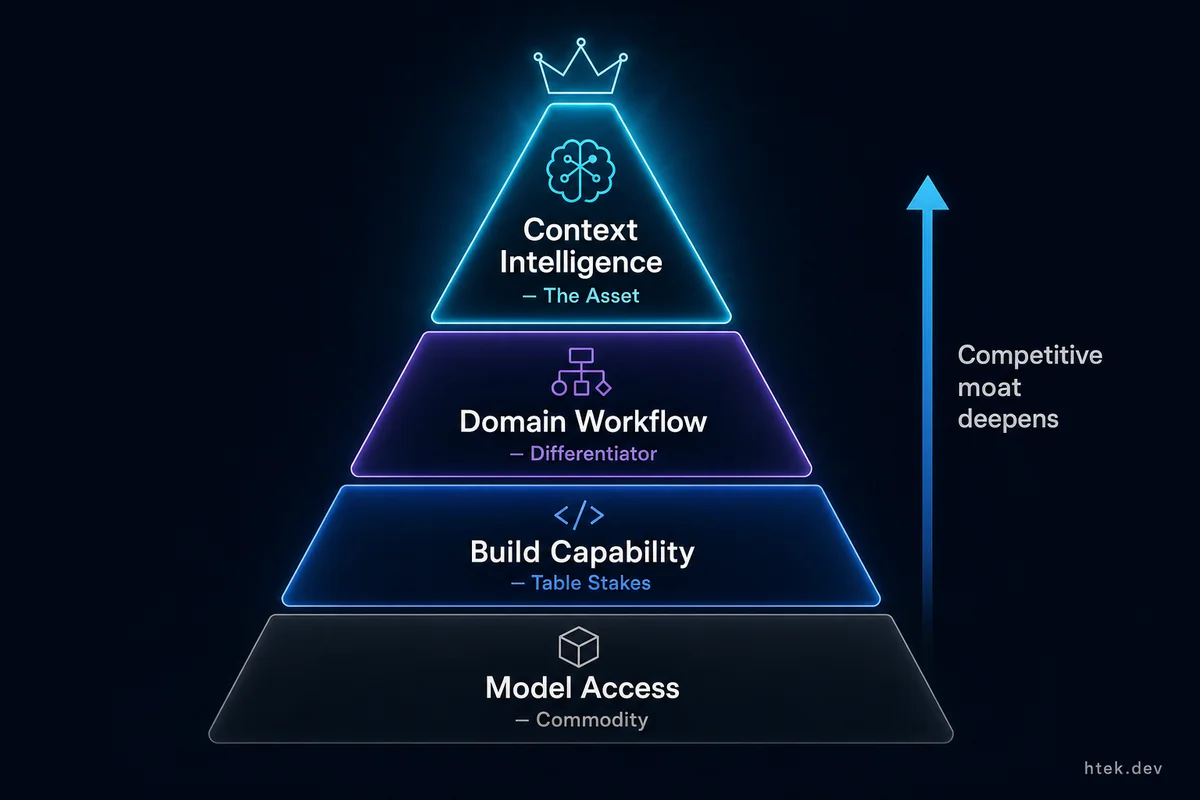 Capability is table stakes. The competitive weapon is knowing which context to inject — and that knowledge only comes from going deep in a vertical.
A generalist with access to the best available model still doesn’t know the compliance calendar of a mid-sized orthopedic device distributor in the Southeast. That knowledge — accumulated through years of patient relationship-building, procedural specificity, and domain learning — can’t be generalized away. It can’t be scraped. It can’t be approximated from public data.
This is why I’ve been thinking about this in terms of vertical specialization, not just “context engineering.” When I wrote about what context engineering actually looks like at scale, the model kept being a commodity — the real discipline was shaping what the model sees. The same principle applies at the company level. The company that owns the vertical owns the best context. Stax’s 2026 analysis of vertical SaaS reached the same conclusion: rather than flattening vertical software, AI is separating the companies with deep domain data from those without it.
Deep wins. Generic loses.
The Agentic Development Company
Here’s the structural opportunity I think we’re dramatically underbuilding toward.
Between the hyperscalers — the foundation model providers building AI infrastructure — and the SMBs and mid-markets that need AI-native workflows, there’s a missing layer. Someone has to own the vertical workflow integration. Someone has to take general-purpose AI capability and make it fluent in the operational language of a specific industry.
That’s the agentic development company.
Not a software consultancy. Not an IT services firm. An agentic-first vertical specialist that builds, owns, and continuously deepens AI-native workflows for one target industry. a16z framed the strategic choice as oil wells vs. pipelines: oil wells drill deep into proprietary data and domain relationships; pipelines move generic data efficiently. The agentic development company is an oil well operation. You go deep on one vertical. You build systems that understand it at a level no horizontal tool can match.
This is the new Accenture moment — but for the long tail of SMBs the original system integrators never served. Every vertical that runs on high-relationship, high-compliance, high-procedural context is an open field right now.
I wrote about this pattern in terms of the agentic development maturity curve: mastery looks like simplicity because experts stop building everything and start targeting what moves the needle. Going vertical is the same principle applied to market strategy. Frameworks don’t execute themselves — and general-purpose software doesn’t execute your specific compliance workflow either. The execution layer belongs to whoever owns the vertical.
The Hunt
I’ve spent most of my career as a general engineer. I can build anything — full-stack, DevOps, agentic systems, enterprise platforms. The breadth was the point. For a long time, it was valuable.
It still is. But the game has changed.
The ability to build is now table stakes. Every ambitious engineer I know can spin up an AI-powered tool in a week. The question is no longer can you build it? It’s which vertical do you own?
I’m on the hunt for mine. I want to take everything I’ve built — the agentic development systems, the DevOps depth, the enterprise platform experience — and target a specific vertical deeply enough that the context I accumulate becomes structurally irreplaceable. Not just a tool. An institution.
Jensen’s framing landed because it confirmed something I’d already felt empirically after that week of building. The model isn’t the advantage. The industry is.
If you’re at the same inflection point — a general engineer who can build anything, wondering whether breadth is still the edge — I’d argue: pick your vertical. Go deep. The context richness will follow.
The moat isn’t your model. It isn’t your framework. It’s the vertical you own.
I’m on the hunt for a vertical worth owning — one where ambitious people want to fundamentally change how their industry runs with AI. If that’s you — if you’re an operator or leader inside a specific vertical, serious about what agentic capability could do there — I want to hear from you. Not looking for a client. Looking for the right vertical.
Resources
- Jensen Huang: Nvidia’s Future, Physical AI, Rise of the Agent — All-In Podcast (YouTube)
- Palo Alto Networks CEO: “AI Found 5 Years of Bugs in 6 Weeks” — All-In Podcast featuring Nikesh Arora (YouTube, June 8, 2026)
- Why AI Moats Still Matter (And How They’ve Changed) — a16z, December 2025
- Oil Wells vs. Pipelines: Two Strategies for Building AI Companies — a16z, August 2025
- Does AI Threaten Vertical SaaS? — Euclid Ventures, June 2025
- Vertical Software Is Having A Moment — Activant Capital, February 2025
- How AI is Reshaping Vertical SaaS — Stax, February 2026
- ServiceBridge — field service management for general contractors