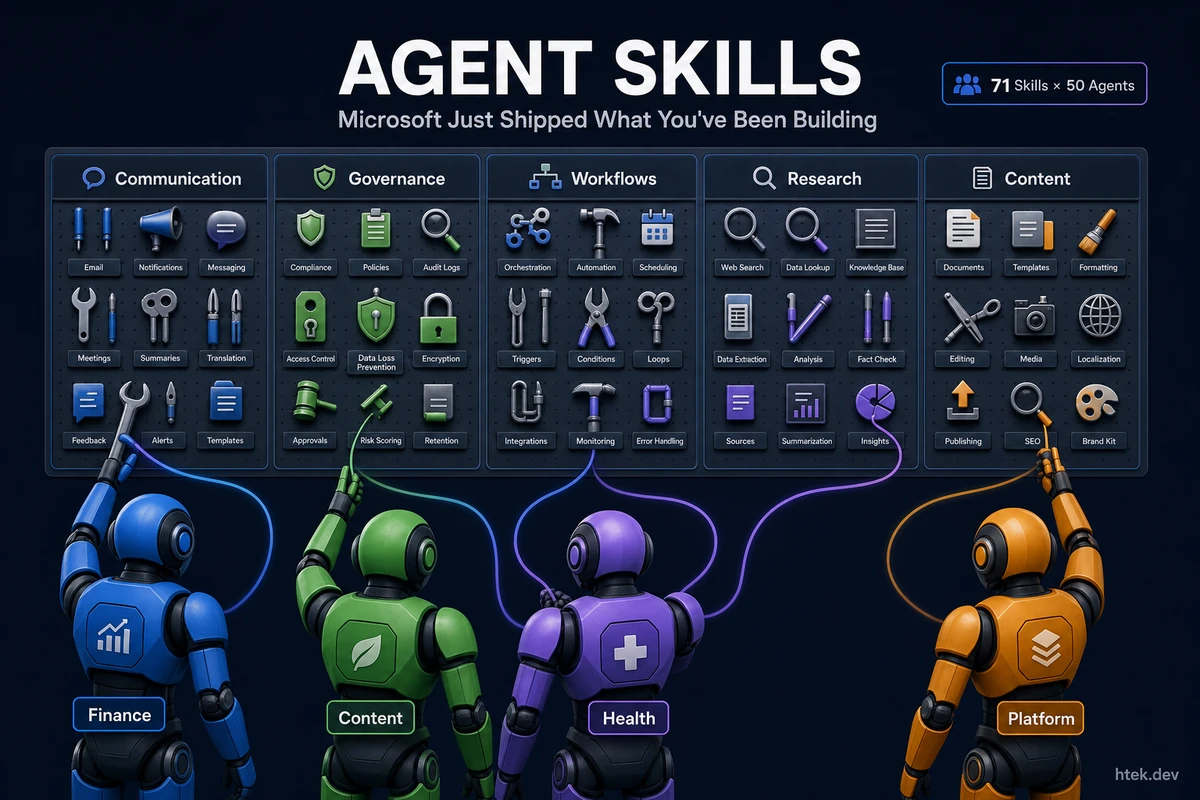
Microsoft Just Validated Your Architecture
On May 13, 2026, Microsoft shipped Agent Skills in Visual Studio — a pattern for giving AI agents reusable, on-demand capabilities instead of cramming everything into prompts. It’s the official productization of what builders like me have been doing for months: extracting repeatable procedures out of agent instructions and loading them only when needed.
I’ve been running 71 skills across 50 production agents on GitHub Copilot since before Microsoft made it official. My family’s entire life — finances, meals, content publishing, home maintenance — runs on this pattern. And the moment Microsoft announced Agent Skills, I knew: this is the architecture that scales.
Want the complete implementation guide with real SKILL.md templates and the Agent vs Skill decision framework? Subscribe to the newsletter → Issue #3 has the step-by-step playbook, code samples, and the full 71-skill taxonomy.
What Are Agent Skills, Actually?
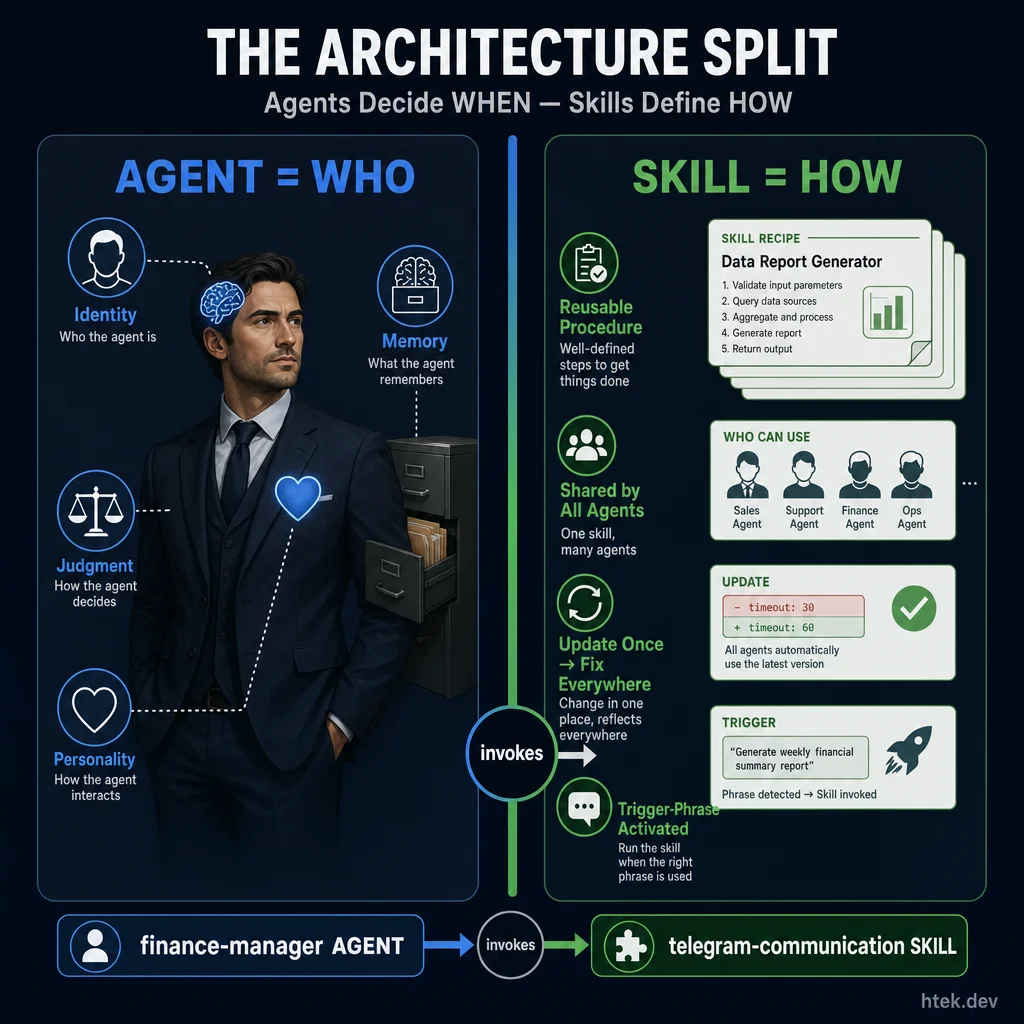 Agents decide WHEN to use a capability. Skills define HOW to execute it. This separation is why 50 agents don’t collapse into spaghetti.
Think of skills as the “How” to an agent’s “Who.”
An agent is identity, memory, judgment, and personality. The finance-manager agent owns budget tracking and bill payments. The content-scheduler agent owns social media queue optimization. Each agent has its own memory files, decision-making authority, and persistent state.
A skill is a reusable procedure, workflow, or integration pattern that any agent can invoke. The quality-gate skill defines the create → review → remediate → merge pattern. The telegram-communication skill defines messaging rules, quiet hours, and text-to-speech formatting. The copilot-brand-safety skill defines pre-publish brand checks for all content.
The agent decides when to use a skill. The skill defines how to do it.
This separation is why my 50-agent system doesn’t collapse into spaghetti. Agents don’t embed the “how to send a Telegram message” logic inline 50 times. They invoke the telegram-communication skill. When I update the skill, all 50 agents get the fix instantly.
This pattern is now mainstream. Microsoft calls them “Agent Skills.” Hugging Face calls them “Hugging Face Skills.” LangChain and CrewAI have their own skill abstraction layers. The entire industry converged on the same solution: agents are the WHO, skills are the HOW.
The 71-Skill, 50-Agent Architecture
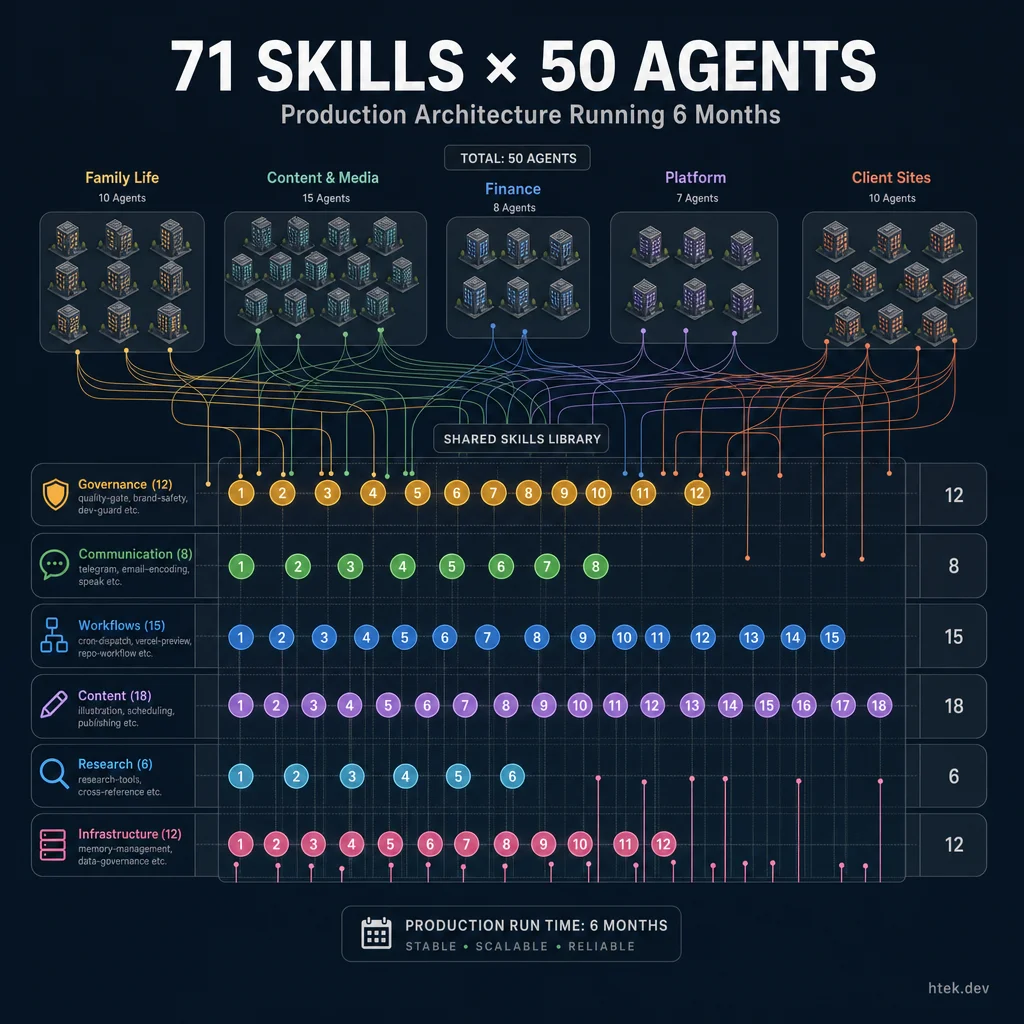 The full production architecture: 71 skills organized into 6 categories, serving 50 domain agents across family life, content, finance, platform, and client work.
Here’s what it looks like in production.I run this on GitHub Copilot CLI — every agent is a Copilot session with custom instructions, every skill is a .github/skills/{name}/SKILL.md file.
Example skills from my platform:
memory-management— 4-tier memory system (core, working, long-term, events) used by every domain agentquality-gate— create → review → fix → recheck → escalate pattern for all platform changescron-dispatch— fresh agent launch pattern for scheduled jobs (never reuse sessions)copilot-brand-safety— brand protection rules for GitHub Copilot / Microsoft mentionstelegram-communication— text-to-speech formatting, quiet hours, per-person message rulesvercel-preview-workflow— branch → PR → preview → approval → merge for all Vercel-connected reposagent-skill-management— decision framework for when to extract a skill vs embed inlinecontent-schedule-maintenance— queue ordering rules, collision detection, bring-forward optimization
Every skill has YAML frontmatter with a name, description, and trigger phrases — the keywords that signal when an agent should load it. The telegram-communication skill triggers on phrases like “send Telegram,” “notify Hector,” “message Paula,” “quiet hours,” “speak param.”
Newsletter Issue #3 has the full skill template, the 71-skill taxonomy broken down by category, and the exact trigger phrase patterns that make progressive disclosure work. Subscribe here →
Progressive Disclosure: Load Skills On-Demand, Not Always-On
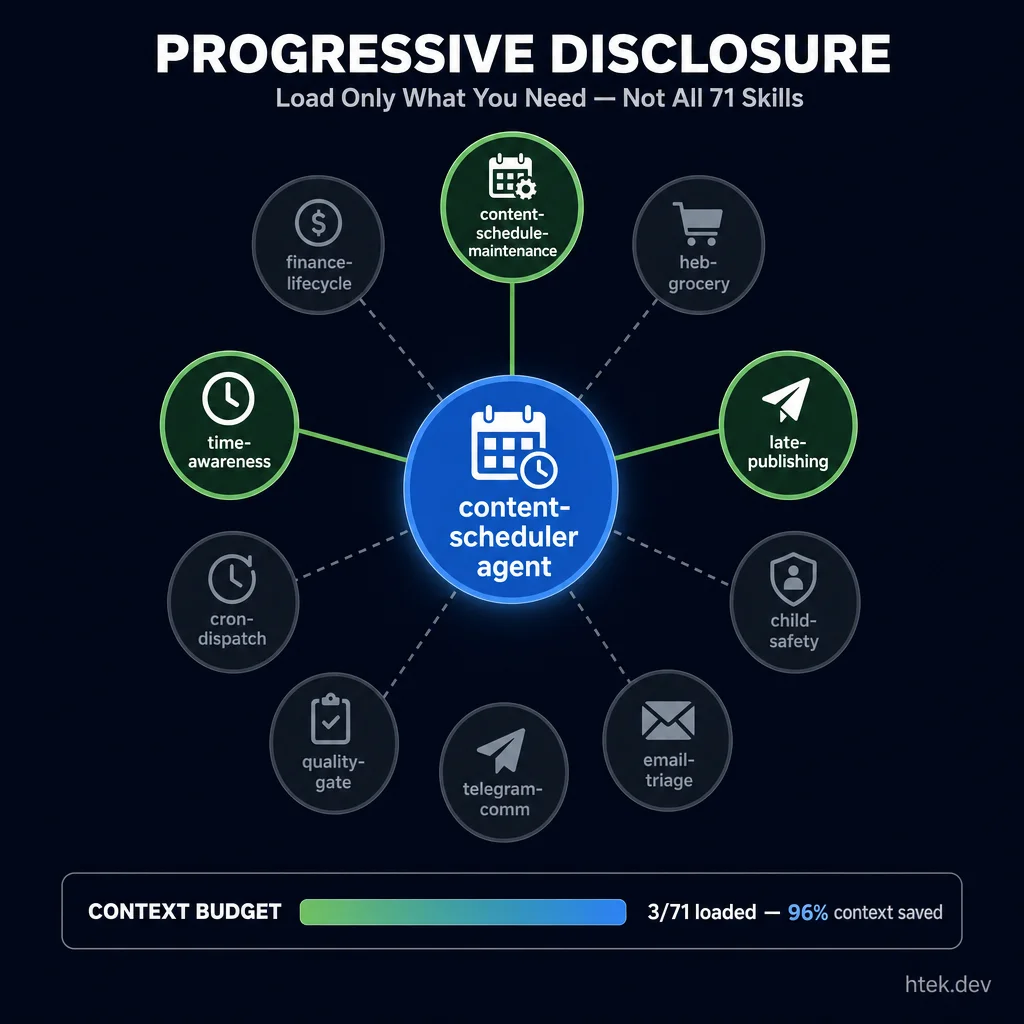 Skills activate on-demand via trigger phrases. The content-scheduler loads only 3 skills for queue optimization — the other 68 stay dormant, saving precious context window space.
This is where the architecture gets elegant.
Your agents don’t load all 71 skills into context every time they run. That would be a 200KB prompt per agent — the god prompt antipattern all over again, just with better organization. Instead, skills load on-demand when their trigger phrases appear in the conversation.
I wrote about the god prompt problem in Your God Prompt Is the New Monolith — how cramming everything into a single prompt mirrors the monolithic backend failures we solved a decade ago. Skills fix the monolith. Progressive disclosure fixes the context explosion.
When my content-scheduler agent optimizes the social media queue, it loads content-schedule-maintenance (queue ordering rules), late-publishing (platform-specific APIs), and time-awareness (date computation rules). It doesn’t load finance-task-lifecycle or heb-grocery or child-safety-protocol — those skills are irrelevant to content scheduling.
The agent’s instructions reference skills by name. The skill loader pattern watches for trigger phrases and injects the skill’s full instructions just-in-time. When the conversation moves to a new domain, irrelevant skills drop out and new ones load in.
How does progressive disclosure actually work in production? Newsletter subscribers get the loader pattern, the context budget strategies, and the skill priority rules that prevent context overflow. Subscribe to Issue #3 →
Cross-IDE Compatibility: Skills Work Everywhere
The .github/skills/ directory structure isn’t GitHub-specific. It’s a file convention. Any IDE, any agent framework, any AI coding tool can read a SKILL.md file.
I run this on GitHub Copilot CLI, but the skills pattern works in:
- Visual Studio — Microsoft’s Agent Skills feature reads from the same structure
- VS Code — Copilot extensions can load skill files
- Claude Projects — upload
SKILL.mdfiles as project knowledge - Generic agent frameworks — LangChain, CrewAI, LangGraph all have skill loaders
The pattern is tool-agnostic. Skills are markdown files with YAML frontmatter. Any agent that can read a file can load a skill.
This is the opposite of vendor lock-in. Your skills library is portable. When the next AI coding tool ships, you copy .github/skills/ into the new repo and your agents already know how to work.
The Pattern That Scales
I wrote the complete context engineering guide in What Is Context Engineering? A Practical Guide from Building 50 Production AI Agents. Skills are the procedural layer of context engineering — the reusable capabilities that agents invoke without embedding inline.
The alternative is the monolith: 50 agents with duplicated logic for “how to send a Telegram message,” “how to create a Vercel PR,” “how to run a quality gate.” When you fix a bug, you fix it 50 times. When you add a feature, you copy-paste across 50 instruction files. Eventually, agents drift out of sync and the system becomes unmaintainable.
Skills solve this. One source of truth. Update once, propagate everywhere.
Microsoft just validated this pattern by shipping it as a first-class feature in Visual Studio. Hugging Face followed with their own skills marketplace. The industry is converging: skills-first architecture is how multi-agent systems scale.
If you’re building with AI agents and you’re NOT using skills yet, you’re fighting the architecture. I’ve written about this pattern in the context of agent harnesses, the home assistant that runs my household, and the convergent architecture emerging across Stripe, Coinbase, and enterprise DevOps platforms.
What You’ll Find in Newsletter Issue #3
This was the overview. The deep dive is in the newsletter.
Newsletter Issue #3 includes:
- The complete SKILL.md template with YAML frontmatter schema
- The Agent vs Skill decision framework — when to extract vs embed inline
- 71-skill taxonomy broken down by category (governance, communication, workflows, content, research, infrastructure)
- Progressive disclosure loader pattern and context budget strategies
- Real skill examples:
quality-gate,memory-management,cron-dispatch,telegram-communication - Trigger phrase patterns and skill priority rules
- Cross-IDE compatibility guide for Visual Studio, VS Code, Claude, and generic frameworks
- Lessons from running 50 agents and 71 skills in production for 6 months
This is the architecture that scales. Microsoft just made it mainstream. Subscribe at htek.dev/newsletter →
Related reading:
- What Is Context Engineering? A Practical Guide from Building 50 Production AI Agents — The complete context engineering playbook
- Your God Prompt Is the New Monolith — Why cramming everything into one prompt fails
- Agent Harnesses: Why 2026 Isn’t About More Agents — It’s About Controlling Them — The infrastructure layer that governs agent systems
- I Open-Sourced the AI That Runs My Household — The 50-agent, 71-skill platform in action
Premium resources:
- 4-Tier Agent Memory System Blueprint ($59) — The memory architecture behind my 50-agent platform
- The Agentic Development Blueprint ($129) — The complete guide to building production-ready agent systems