
You finally found one. An engineer on your team who isn’t just using Copilot for autocomplete — they’re building agents, orchestrating multi-step workflows, shipping automation that replaces entire manual processes. They’re your agentic unicorn, and they’re producing at a level that makes everyone else’s output look like a rounding error.
Now someone in leadership wants them to run training sessions. “Scale the knowledge,” they say. “Get the rest of the team up to speed.” On paper, it sounds reasonable. In practice, it’s the most expensive resourcing mistake you can make in 2025.
The 5% Who Change Everything
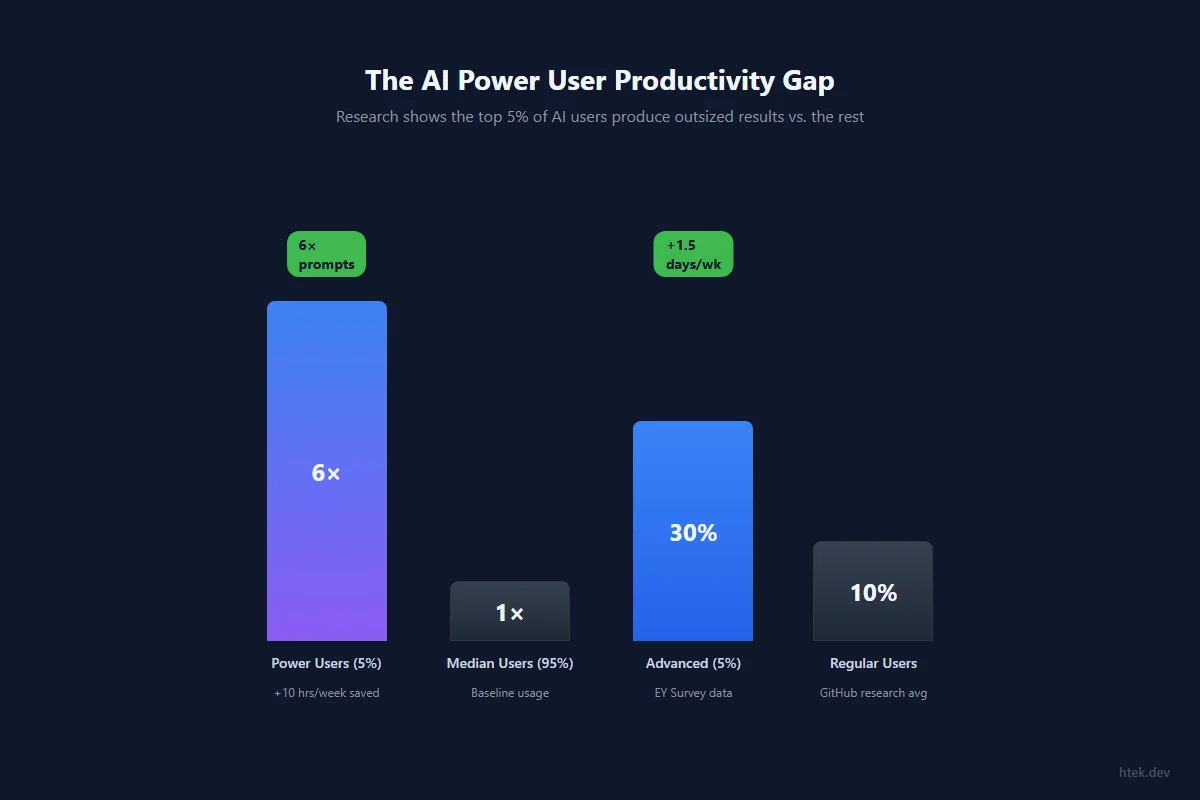 The AI productivity gap: research from OpenAI, EY, and GitHub shows the top 5% of users produce outsized results
Here’s what the data actually shows about AI adoption in engineering organizations: the gains are not evenly distributed.
An EY survey found that only about 5% of workers qualify as “advanced AI users” — but those users gain roughly 1.5 extra productive days per week compared to their peers. That’s not a marginal improvement. That’s a 30% capacity expansion from a fraction of your workforce.
OpenAI’s own enterprise data tells a similar story. Users in the 95th percentile of AI adoption send 6× more prompts than the median user. For coding tasks specifically, that number jumps to 17×. These power users report saving over 10 hours per week — and the gap between them and everyone else is widening, not closing.
GitHub’s research across thousands of developers places active AI users in a 10-26% productivity improvement range, with power users clustering at the upper end. And it’s not just speed — 73% of users reported staying in flow longer and 87% said Copilot conserved mental effort. The cognitive benefits compound over time in ways that raw throughput metrics don’t capture.
These aren’t mythical 10x engineers. They’re regular engineers who’ve invested deeply in understanding how agentic platforms work. As I wrote about in my article on the realistic ROI numbers from Stanford’s research, the median gain is 10-15%. Power users are the ones who push well past that median.
The Math on Vertical vs. Horizontal Scaling
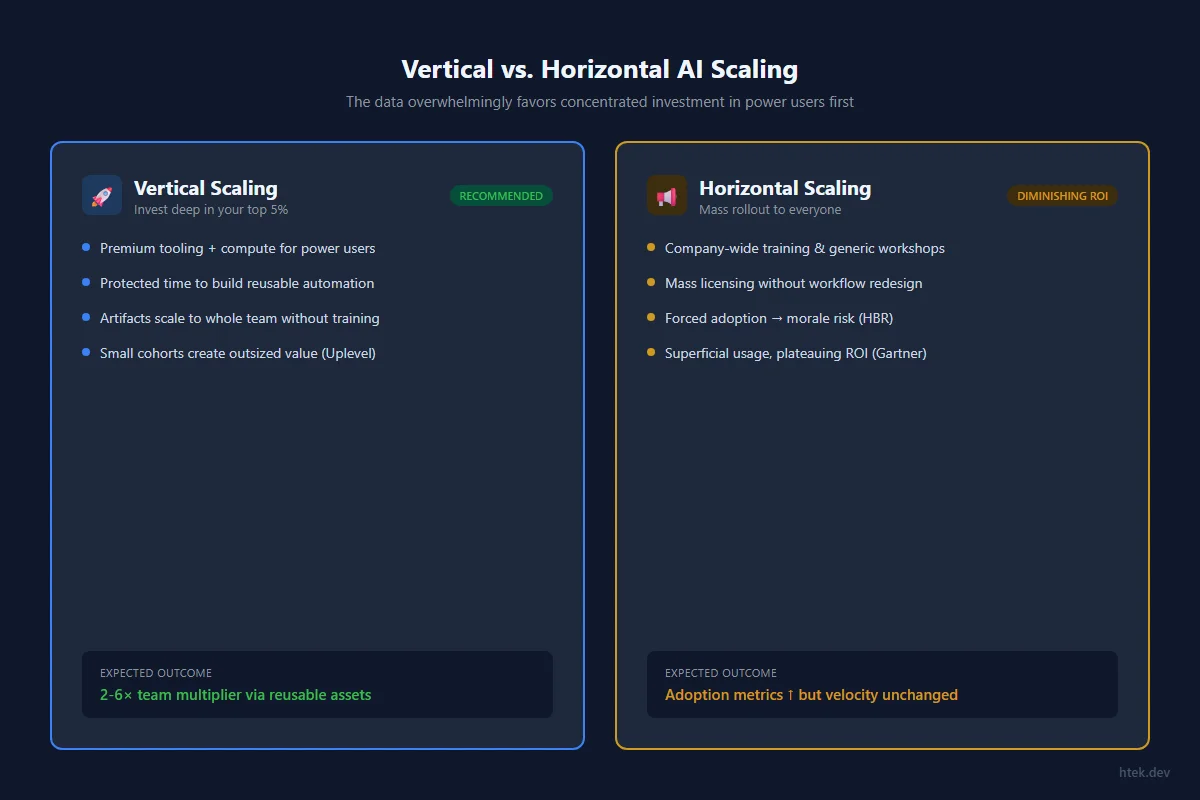 Vertical scaling (deep investment in power users) vs. horizontal scaling (mass rollout) — the data overwhelmingly favors concentrated investment first
Here’s the resourcing question every engineering leader needs to answer: do you scale vertically (concentrate resources on your power users) or horizontally (broad training programs for everyone)?
Vertical scaling means giving your agentic unicorns premium tooling, compute, dedicated time, and a mandate to build reusable automation. You’re investing deeply in a small cohort to maximize their multiplier effect.
Horizontal scaling means company-wide training, mass licensing, and generic workshops aimed at getting the entire engineering org to some baseline AI proficiency.
The data overwhelmingly favors vertical — at least as the starting point.
Uplevel’s engineering analytics show that small cross-functional “super-employee” cohorts create outsized value compared to uniform rollouts. When a power user builds a reusable agent or workflow template, that artifact scales to the entire team without requiring the power user to sit in a conference room explaining prompt engineering to people who’d rather not be there.
Gartner’s 2026 technology adoption roadmap explicitly recommends benchmarking adoption plans before mass rollouts — because the marginal return on each additional license and training seat diminishes rapidly, especially when you’re pushing tools on engineers who are slow to adopt or actively resistant.
McKinsey’s State of AI 2025 found that only about a third of organizations have reached enterprise-wide AI scaling. The high performers? They redesign workflows first and invest in AI talent — they don’t just hand out licenses and hope.
This maps directly to what I’ve seen with how agentic AI is transforming dev teams. The teams winning aren’t the ones with the most seats. They’re the ones with the deepest practitioners.
The Hidden Cost of Pulling Unicorns Off the Field
Every hour your agentic unicorn spends running a training session is an hour they’re not:
- Building the automation that eliminates two manual steps for the entire team
- Creating agent templates that other engineers can consume without training
- Shipping features at 2× the velocity of their peers
That’s the opportunity cost, and it’s staggering. But it gets worse.
HBR’s research on AI adoption shows that forced adoption without workflow redesign produces diminishing returns and morale risk. You can’t mandate enthusiasm. When leadership pushes AI tools without trust-building and role-based enablement, you get superficial usage, plateauing ROI, and — in the worst cases — increased attrition among experienced staff who feel the tools are being imposed on them.
There’s also the quality angle. Jellyfish’s analysis documents that AI-generated code frequently introduces security and maintainability risks when engineers accept suggestions uncritically. Broad, shallow adoption — the kind you get from generic training programs — produces exactly this pattern. Meanwhile, your power users have learned context engineering and understand how to get quality output from these tools.
I’ve written about turning AI skeptics into believers, and I stand by that work. But here’s the nuance leadership misses: conversion has a cost, and the person paying that cost should not be your highest-leverage contributor.
What Smart Leaders Actually Do
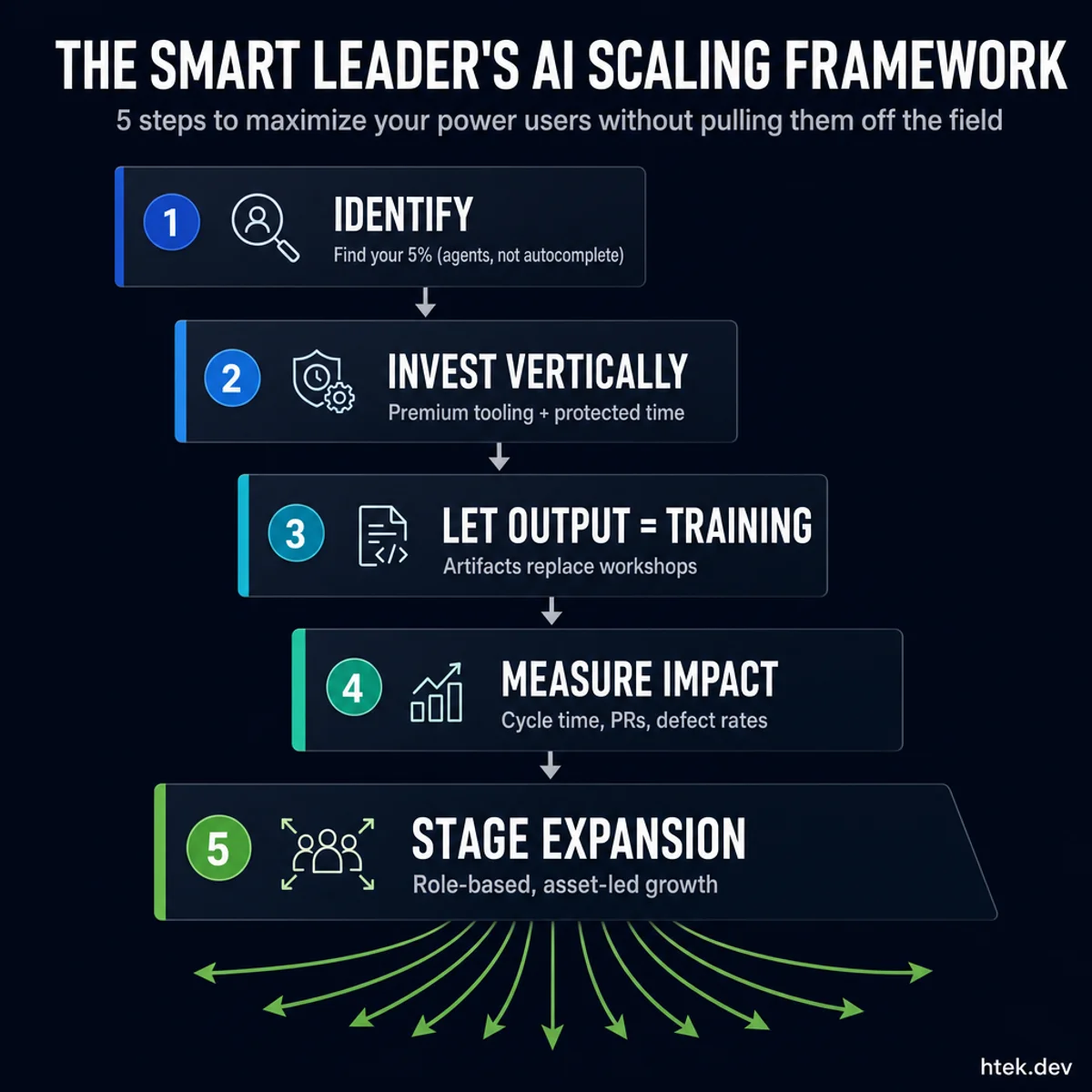 The Smart Leader’s AI Scaling Framework — 5 steps to maximize power users without pulling them off the field
If you’re an engineering leader looking at your AI adoption strategy, here’s the framework that actually works:
-
Identify your unicorns — Look for engineers who are already deep into agentic platforms. Not just Copilot autocomplete — agents, custom workflows, multi-step automation. The ones who are building the future on their own time because they can’t help it.
-
Invest vertically first — Give them premium tooling, compute budget, protected time, and a clear mandate: build reusable assets that raise the entire team’s capability. They are your AI Center of Excellence, whether you call it that or not.
-
Let their output be the training — When a unicorn builds an agent template or automation workflow, adoption becomes consumption, not instruction. Other engineers don’t need a workshop — they need an artifact they can use. This is how you scale horizontally without pulling anyone off the field.
-
Measure what matters — Track cycle time, PR throughput, merge frequency, and defect escape rates. A peer-reviewed CACM study validated these as meaningful AI productivity indicators. “Number of training sessions completed” is not a KPI — it’s theater.
-
Stage horizontal expansion with purpose — When you’re ready to broaden, use your power users’ artifacts as the foundation. Create role-based learning paths. Measure impact at each stage. This is what Microsoft’s Cloud Adoption Framework for AI recommends, and it works because it’s asset-led, not calendar-led.
The research on developer fulfillment with AI tools shows 60-75% satisfaction boosts — but those numbers come from engineers who adopted by choice, not by mandate. Respect the adoption curve. Fund the front of it.
The Bottom Line
Your agentic unicorn shipping one reusable automation is worth more than 10 training sessions for reluctant adopters. The data from every major research firm — McKinsey, Gartner, HBR — converges on the same conclusion: concentrated investment in high-leverage AI users produces faster, more durable ROI than uniform broad rollouts.
As agentic platforms mature and the gap between power users and everyone else widens, the leaders who invested vertically will own the next era of engineering productivity. The ones who pulled their unicorns off the field to run workshops? They’ll be wondering why their AI adoption metrics look great on paper but their delivery velocity hasn’t moved.
Invest in your unicorns. Let the artifacts do the scaling. The multiplier is real — stop wasting it.