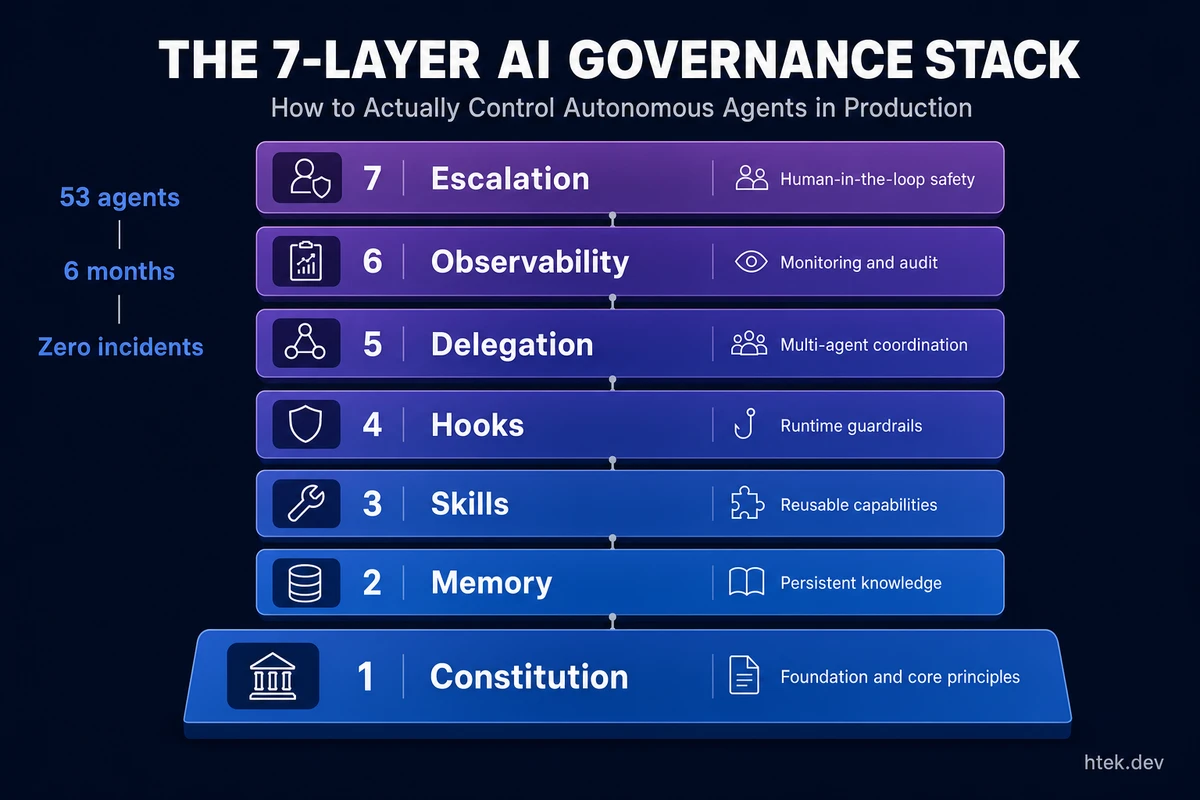
53 Agents, 6 Months, Zero Incidents
I run 53 autonomous AI agents on GitHub Copilot that manage my family’s finances, meals, home maintenance, content publishing, and even NICU care coordination for our premature twins. They execute on 57 cron jobs. They make real decisions — moving money, sending messages, creating PRs, scheduling appointments.
Six months. Zero incidents. Not because my agents are simple, but because they’re governed.
Here’s what nobody talks about in the “just ship agents” hype cycle: the moment your agent does something real — sends a message, moves money, deploys code — you need governance. Not “AI safety” in the abstract research sense. Operational governance. The kind that prevents your meal-planning agent from accidentally spending $500 at the grocery store.
I built a 7-layer governance stack through six months of production iteration. This article gives you the overview. The newsletter issue has the complete implementation with code for every layer.
The Problem Nobody’s Solving
Most “AI safety” discourse focuses on chatbot guardrails — preventing language models from saying harmful things. That’s important, but it’s completely irrelevant to operational agents.
When you have 53 agents running autonomously on cron schedules, the danger isn’t that one says something inappropriate. The danger is that one does something inappropriate — sends the wrong message, overspends a budget, deploys untested code, or leaks personal information.
I’ve written about the three architectural layers that prevent agent chaos, and about how 53 agents coordinate without a central brain. But orchestration without governance is just organized chaos. You need both.
The industry is starting to recognize this. Microsoft published their AI agent security framework emphasizing that agents need first-class infrastructure controls. NVIDIA shipped OpenShell for sandboxing agent operations. But most teams are still shipping agents with nothing but a system prompt and a prayer.
The 7 Layers (Overview)
Here’s what my governance stack looks like — from highest-level principles down to runtime enforcement:
Layer 1: The Constitution
A single markdown file that every agent loads first, before their own instructions. It defines core principles, communication rules, and behavioral boundaries that apply universally. Think of it as the “Bill of Rights” for your agent system — the rules that no individual agent can override.
Layer 2: Tiered Autonomy
Not every action carries the same risk. My system classifies every possible agent action into three tiers: act immediately (low risk, high frequency), ask first (medium risk, needs confirmation), and escalate (high risk, requires human review). Each agent has its own autonomy matrix tailored to its domain.
Layer 3: Approval Gates
For anything above tier 1, agents must request approval through a structured gate. This isn’t a vague “check with the user” instruction — it’s a concrete mechanism with task creation, notification routing, and timeout handling. If approval doesn’t come within a window, the action is abandoned, not retried.
Layer 4: Safety Protocols
Domain-specific safety rules that override everything else. My child-safety protocol, for example, requires verified caregiver handoffs before updating location data. My financial protocol caps single transactions and requires dual confirmation for amounts over threshold. These are the “circuit breakers” — they fire regardless of what the agent thinks it should do.
Layer 5: Code Guards (Hookflows)
Runtime enforcement at the tool level. Before any agent can execute a shell command, write a file, or make an API call, hookflow rules validate the operation against governance policies. This catches things that slip past the prompt-level layers — an agent that’s been instructed correctly but hallucinates a dangerous command.
Layer 6: Context Isolation
Agents can only access data within their domain. My finance agent can’t read health records. My content agent can’t access family logistics. This isn’t just prompt-level trust — it’s enforced through file system boundaries, data ownership maps, and cross-domain write rules.
Layer 7: Brand Safety
Content-producing agents have an additional layer that prevents them from mentioning specific employers, sharing confidential information, or publishing content that could damage professional relationships. This layer runs pre-publish checks with pattern matching and automated review.
Deep Dive: The Autonomy Matrix (Layer 2)
Let me show you one layer in detail to prove this isn’t theoretical.
Every agent in my system has a decision framework with three categories. Here’s a simplified example from my finance agent:
Act Immediately (no confirmation):
- Record a transaction from a bank notification
- Categorize a recurring expense
- Update budget tracking numbers
Ask First (requires approval):
- Pay a bill over $100
- Transfer money between accounts
- Change a budget category allocation
Escalate (requires human review):
- Any transaction over $500
- Opening a new account or credit line
- Changing payment methods on autopay
This isn’t a suggestion — it’s enforced. If the finance agent tries to execute a “pay bill” action without approval in the session transcript, the hookflow governance layer blocks the tool call. The agent literally cannot bypass the gate.
The key insight: autonomy should be granular, not binary. Most teams either give agents full autonomy (dangerous) or require approval for everything (useless). The matrix approach gives you speed where it’s safe and control where it matters.
Why This Matters Now
The agent landscape is exploding. Stripe runs 1,300+ PRs per week through autonomous coding agents. Coinbase, Ramp, and dozens of enterprises are shipping production agent systems. But governance is an afterthought at best.
If you’re building agents that do real things — not just answer questions — you need a governance stack. Not eventually. Now. Before your first incident teaches you why.
I’ve been iterating on this for six months. The context engineering principles that underpin it are the same ones that make the agents useful in the first place — you’re just applying them to safety instead of capability.
Go Deeper
This article is the overview — enough to understand the architecture and start thinking about your own governance needs.
The newsletter issue has the implementation. All 7 layers with real code, real configs, and real examples from a system that’s been running autonomously for 6 months. Subscribe to get Issue #7 →
The blueprint has the step-by-step build guide. If you want to implement this yourself, the 4-Tier Agent Memory System blueprint (Chapter 14) gives you the complete walkthrough with production-ready templates.
Want to build faster? The Agentic Development Blueprint covers the full platform architecture, and the Copilot Life OS Blueprint shows how to apply it to personal automation.
Need help implementing governance for your agent system? I consult with teams building production multi-agent platforms. Let’s talk →